


Office Address
123/A, Miranda City Likaoli Prikano, Dope
Phone Number
+0989 7876 9865 9
+(090) 8765 86543 85
Email Address
info@example.com
example.mail@hum.com


123/A, Miranda City Likaoli Prikano, Dope
+0989 7876 9865 9
+(090) 8765 86543 85
info@example.com
example.mail@hum.com
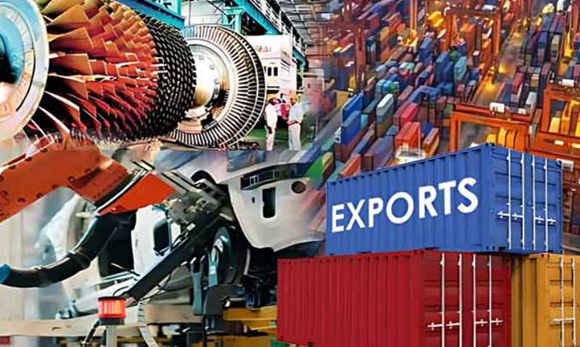
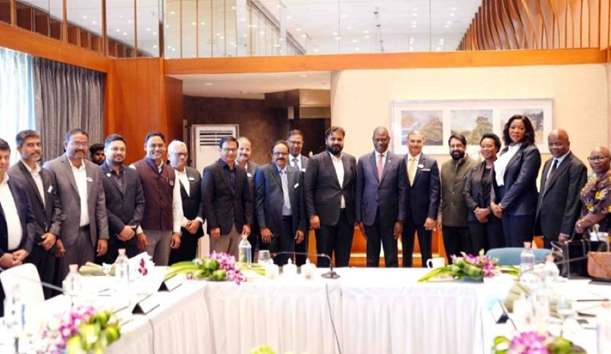
The achievement was highlighted at a press conference
in Goa jointly organized by the Department of Commerce, the Directorate General
of Foreign Trade (DGFT), and EEPC India.
Speaking at the
event, Vimal Anand said engineering exports have become the largest contributor
to India’s merchandise exports, accounting for nearly 28% of the country’s
total merchandise exports. He noted that the sector has demonstrated strong
resilience despite geopolitical uncertainties, supply chain disruptions, and
evolving global trade dynamics. According to Anand, Indian engineering products
now enjoy a strong presence across major global markets, including North
America, the European Union, and other advanced economies, reflecting the
quality and reliability of Indian manufacturing. He emphasized that exports
continue to play a crucial role in economic growth, employment generation, and
India’s integration into global value chains. Highlighting government support,
Anand said sustained engagement with industry stakeholders has enabled timely
policy interventions and effective responses to challenges, including recent
disruptions in trade routes and logistics networks linked to geopolitical
developments in West Asia. He also pointed to
India’s free trade agreements with partners such as the United Kingdom,
European Union, United Arab Emirates, Australia, and EFTA countries, which are
expected to create new opportunities for exporters by reducing trade barriers
and improving competitiveness. Government initiatives including the Market
Access Initiative (MAI) Scheme, Brand India Engineering Campaign, Production
Linked Incentive (PLI) Scheme, National Single Window System (NSWS), Quality
Control Orders (QCOs), and the One District One Product (ODOP) Scheme have
further strengthened the export ecosystem. As a result, engineering exports
have recorded three consecutive years of growth, increasing from USD 109.3
billion in FY 2023-24 to USD 116.67 billion in FY 2024-25 and reaching USD
122.43 billion in FY 2025-26.
Ashwin R. Golapkar highlighted key policy measures
supporting export growth, including the Export Promotion Mission with an outlay
of ₹25,060 crore for 2025-31. He said the initiative aims to provide a unified
digital framework for export promotion and support. Golapkar also emphasized
reforms under the Foreign Trade Policy designed to create a district-driven,
digital, and MSME-friendly export ecosystem. He noted that the DGFT Trade
Connect Platform serves as a single-window interface linking exporters with
DGFT, Export Promotion Councils, Indian Missions abroad, and EXIM Bank, while
helping businesses better utilize free trade agreements and market
intelligence. Additionally, schemes such as the Interest Equalisation Scheme
and the Emergency Credit Line Guarantee Scheme (ECLGS) have helped ensure
affordable export finance and liquidity support, particularly for MSMEs.
Pankaj Chadha said
India remains one of the world’s fastest-growing major economies, supported by
strong macroeconomic fundamentals and a resilient domestic market. He described the engineering sector as one of the
country’s most dynamic industrial segments and a key driver of export growth.
Chadha noted that western India contributed nearly 39% of the country’s
engineering exports, with shipments valued at USD 47.5 billion during FY
2025-26. Despite global challenges such as slowing demand, financial
tightening, and currency volatility, Indian exporters have continued to perform
strongly with the support of targeted government measures. Adhip Mitra welcomed
the government’s continued support for the sector and highlighted upcoming
initiatives, including the Bharat Trade Net digital trade platform, expanded
credit guarantee coverage for exporting MSMEs, and customs duty rationalisation
measures aimed at further enhancing India’s export competitiveness.