

Office Address
123/A, Miranda City Likaoli Prikano, Dope
Phone Number
+0989 7876 9865 9
+(090) 8765 86543 85
Email Address
info@example.com
example.mail@hum.com


123/A, Miranda City Likaoli Prikano, Dope
+0989 7876 9865 9
+(090) 8765 86543 85
info@example.com
example.mail@hum.com

We now estimate the potential to be 16,000
ships, or 700m deadweight tonnes (DWT), from previously 15,000. The new
estimate equals twice the number of ships, and nearly triple the DWT, recycled
over the last 10 years and highlights the need for investments in compliant
recycling facilities,” says Niels Rasmussen, Chief Shipping Analyst at BIMCO.
Applying the recycling patterns seen between year 2000
and 2019 for each ship segment and type, we have calculated the recycling
potential for the next 10 years. If on average 10% of all 20-year-old capesizes
were recycled between 2000 and 2019, we have assumed the same recycling
frequency for the coming 10 years. The 2000-2019 period saw both very low and
high recycling wherefore we believe it provides a good foundation for
calculating the future potential. “During
the 2015-2024 period, ships built in the 1990s made up 35% of the ships and 62%
of the DWT recycled. During the 2000s, 31% more ships were built equal to a
115% DWT increase. The ships built in this period are expected to dominate
recycling in the coming 10 years,” says Rasmussen.
In fact, only 3% of the ships and 5% of the DWT built
during the 2000s have currently been recycled whereas the same is true for 20%
of the ships and 67% of the DWT built in the 1990s. Combined, the three largest
sectors, bulker, tanker and container ships, naturally make up most of the
future recycling potential: 91% of the DWT. However, they only make up 53% of
the ships, and general cargo and fishing ships each contribute nearly as many
ships as each of the three large sectors. During
2015-2024, Bangladesh, India and Pakistan continued to be the largest recycling
destinations, making up 86% of DWT and 58% of ships recycled. The three
countries’ dominance was even more pronounced after 2017 as China stopped
recycling international ships and has since recycled less than 2% of DWT.
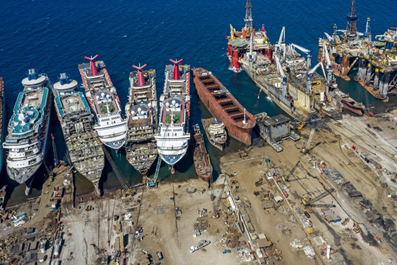
Outside of South Asia, Turkey remains a sizeable recycling location, especially
for offshore ships.
Even though projects exist to expand recycling
capacity elsewhere, we expect the majority of recycling will still take place
in South Asia for some time to come.
The current record high recycling volume was achieved in 2012 with
nearly 1,800 ships and 60m DWT recycled. The potential recycling volume for the
coming 10 years is meantime so high that DWT volumes recycled in every year
starting from 2027 could exceed this record. “Actual recycling may naturally end lower than our calculated potential
if the supply/demand balance is particularly strong. On the other hand, it
could end higher due to weak markets and the need for replacing older tonnage
to reduce greenhouse gas emissions. In either case, we find it overwhelmingly
likely that recycling will end significantly higher than in the past while
recycling facilities at the same time need to ensure compliance with the
stricter requirements of the Hong Kong convention,” says Rasmussen.
Note: Ship sectors included in the data and forecast
are dry bulk, tanker, container, gas tankers, general cargo, other dry cargo,
offshore and inland waterways.