

Office Address
123/A, Miranda City Likaoli Prikano, Dope
Phone Number
+0989 7876 9865 9
+(090) 8765 86543 85
Email Address
info@example.com
example.mail@hum.com


123/A, Miranda City Likaoli Prikano, Dope
+0989 7876 9865 9
+(090) 8765 86543 85
info@example.com
example.mail@hum.com
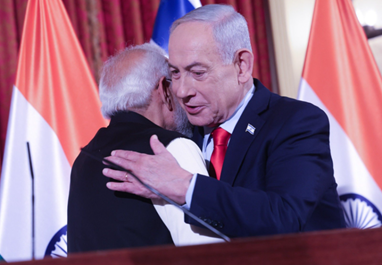
“In today’s
meeting, we discussed giving new direction and greater momentum to our
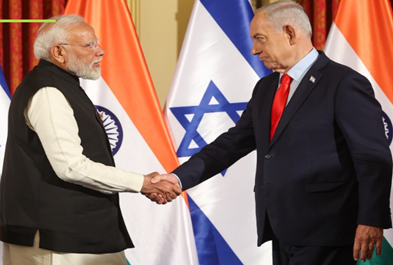
cooperation,” Modi said at a joint press briefing with Israeli PM Benjamin
Netanyahu after the two leaders held delegation-level talks in Jerusalem.
The discussions
covered a raft of areas including defence and security, technology and
innovation; cybersecurity; trade, investment and connectivity; agriculture,
water and environmental protection; combating terror and promoting peace;
parliamentary cooperation; health; education; and people-to-people exchanges.
“The leaders noted
the immense progress made in the India-Israel bilateral relationship across
diverse domains, including emerging technologies, cyber, agriculture, water
management, health, entrepreneurship, defence, security, and more. Prime
Minister Netanyahu and Prime Minister Modi agreed and decided to elevate the
Strategic Partnership to a new level – ‘A Special Strategic Partnership for
Peace, Innovation & Prosperity,’” said a joint statement issued in
Jerusalem.
At a special press briefing later, foreign secretary
Vikram Misri said the US-Iran tensions and the overall regional situation
figured in the discussions between the two PMs.
“The PM (Modi) reiterated India’s firm belief in the
value of dialogue and pursuing peaceful solutions to all such issues. He also
reiterated India’s readiness to offer its support for a peaceful solution of
issues,” Misri said.
On a question about
what role India could play in the post-conflict reconstruction of Gaza, he
said, “We do see a role. What exactly that role will be depends on a little
more clarity on how things will develop on the ground in Gaza. I am not going
to speculate at this point in time on the exact areas in which we may come in,
but India has very specific capabilities and capacities which would be of
considerable relevance in a situation like the one we see on the ground in
Gaza. We do have the capacity to contribute,” he added.
Several outcomes
were finalised during the talks including in the areas of technology, science,
trade, financial services, artificial intelligence, cybersecurity, agriculture,
blue economy, labour mobility, education and culture. The outcomes included 17 memoranda of
understanding or agreements, and 10 other announcements, including one on
elevation of the relationship to special strategic partnership. “Our ties have stood the test of time.
Our economic cooperation continues to serve as an engine of growth, innovation,
and shared prosperity. Last year, we signed a Bilateral Investment Agreement to
promote mutual investments. We will also soon finalise a mutually beneficial
Free Trade Agreement,” Modi said at the press briefing. The leaders asserted their commitment to
realising the FTA and tasked the negotiating teams to expedite negotiations for
an early conclusion, the statement said.
Technology lies at the heart of the future partnership between the two
countries, Modi said. “Today, we
decided to establish a Critical and Emerging Technologies Partnership. This
will impart fresh momentum to cooperation in areas such as AI, quantum
technologies, and critical minerals,” the PM said at the media briefing. India and Israel believe that this
initiative on critical and emerging technologies, led by the national security
advisors of both countries, will synergise their individual strengths in niche
technologies, fostering a focused and futuristic partnership.
The joint statement said both leaders provided a
vision and a road map for future defence cooperation, following the MoU signed
last November to boost defence cooperation…The MoU was signed in Tel Aviv last
November to provide a unified vision and policy direction to deepen the already
strong defence cooperation between the two countries; it will enable the
sharing of advanced technology and promote the co-development and co-production
of weapons and systems…“I am pleased that
an agreement has been concluded to enable the use of UPI in Israel. We are also
committed to improving the lives of our people by sharing our experiences in
the field of digital health,” Modi said…The
Centres of Excellence in agriculture established in India with Israeli
cooperation are a shining example of our friendship. We have set a target of
increasing their number to 100 (from the current 43),” the PM said…Modi
described people-to-people ties as an important pillar of the India-Israel
relationship, adding that through the 2023 Manpower Mobility Agreement, India
has made significant contributions to Israel’s construction and care-giving
sectors…Modi said India and Israel are unequivocal that terrorism has no place
in the world and cannot be tolerated in any form. He added that New Delhi’s
security interests are directly linked to peace and stability in West Asia…The
two leaders unequivocally and strongly condemned terrorism, in all its forms
and manifestations including cross-border terrorism. They called for decisive
and concerted international efforts to combat terrorism in a comprehensive and
sustained manner, reaffirming their collective resolve to combat the menace as
the leaders of two vibrant and resilient democracies…“They strongly condemned
the heinous October 7, 2023 terror attack on Israel, the savage terror attack on
Indian tourists at Pahalgam in Jammu & Kashmir in India on April 22, 2025
and the terror incident near Red Fort, New Delhi on November 10, 2025,” the
statement said.
The PM announced Mission Sudarshan Chakra in his
Independence Day address last year and set a 10-year deadline for developing
the national defence shield, which is expected to integrate some Israeli
technologies and missile systems.