

Office Address
123/A, Miranda City Likaoli Prikano, Dope
Phone Number
+0989 7876 9865 9
+(090) 8765 86543 85
Email Address
info@example.com
example.mail@hum.com


123/A, Miranda City Likaoli Prikano, Dope
+0989 7876 9865 9
+(090) 8765 86543 85
info@example.com
example.mail@hum.com
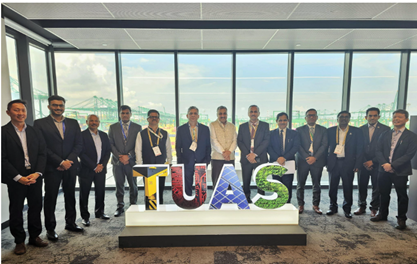
The delegation
included Shri
Venkatesapathy S, IAS, Joint Secretary (Ports, IT & E-Governance), Shri
Susanta Kumar Purohit, IRSEE, Chairperson of V.O. Chidambaranar Port Authority,
and Dr. Shilpak N. Ambule, IFS, High Commissioner of India to
Singapore, along with other senior officials.
During the visit, the delegation was given an in-depth
overview of Tuas Port’s cutting-edge infrastructure, including its use of
automated quay cranes, driverless automated guided vehicles (AGVs), and a
highly integrated digital command-and-control system that enables seamless,
real-time operations. The port’s focus on sustainability—through
energy-efficient systems, electrification, and green port initiatives—was also
highlighted as a model for next-generation maritime hubs. Officials engaged in detailed discussions
with representatives of PSA International, the developer and operator of Tuas
Port, on topics such as port automation, digitalization of logistics chains,
cybersecurity frameworks, and capacity optimization strategies. The interaction
also explored opportunities for knowledge exchange and potential collaboration
in port-led development.
The visit provided
valuable insights into how large-scale ports can leverage technology to enhance
productivity, reduce turnaround times, and improve overall supply chain
resilience. It also aligned with India’s broader vision under the Maritime
India Vision 2030 and Amrit Kaal roadmap, which emphasize the development of
smart ports, adoption of advanced technologies, and creation of globally
competitive logistics ecosystems.
Shri Vijay Kumar noted that India is actively pursuing
modernization initiatives across its major ports, focusing on automation,
digitization, and green energy integration. He emphasized that learnings from
global leaders like Tuas Port will play a crucial role in shaping India’s
future-ready port infrastructure and strengthening its position in
international trade. The visit marks another step forward in deepening maritime
cooperation between India and Singapore, while reinforcing India’s resolve to
build efficient, sustainable, and technologically advanced port systems capable
of supporting the country’s growing trade ambitions.