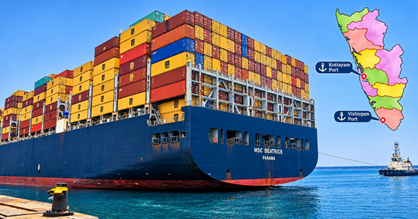
MRF rubber imports to link Vizhinjam with Kottayam ICD in a new cargo arrangement
The shipment comprises 60
containers covered by three Bills of Lading, each accounting for 20 containers.
The containers have been discharged at Vizhinjam and are expected to reach
Kottayam by road on 23 November MRF
has designated Vizhinjam as the Port of Destination to avoid the existing
transhipment arrangement through Mumbai. According to VISL, that routing can
take up to a month. Using Vizhinjam
for discharge, followed by inland clearance at Kottayam, is expected to shorten
transit time and reduce logistics costs. However, the announcement does not
quantify the anticipated savings or specify a revised end-to-end delivery
time. The arrangement connects the
seaport with an inland customs facility, allowing the importer to complete
clearance closer to its regional distribution operations. The movement
announced for this consignment is by road.
At Kottayam ICD, the containers grouped under each Bill of Lading will
undergo customs verification, examination and other mandatory procedures.
Once Customs grants Out of
Charge (OOC) clearance, the containers will continue on the same trucks to
MRF’s centralised warehouse in Kochi. The sequence combines port discharge,
inland clearance and warehouse delivery within one transport arrangement. The proposal also provides for the reuse
of empty containers. After the rubber is unloaded at MRF’s warehouse, the
containers could be returned to Kottayam ICD’s yard and made available for
export cargo. Exporters currently
often arrange for empty containers to be transported from Kochi to Kottayam
before loading their goods. Locally available equipment generated by imports
could reduce this repositioning requirement and support faster container reuse,
according to the announcement. This
remains an intended benefit of the arrangement, with actual savings dependent
on matching the available containers with exporters’ requirements. Kottayam Port and Container Terminal
Services began full operations as a customs station in 2012. Kerala’s Economic
Review 2025 identifies it as the state’s only ICD and records cargo handling of
60,575 tonnes during 2024–25.
Situated on the Kodoor River, National Waterway 9, the facility connects
with Vembanad Lake and has inland-waterway access towards Cochin through
National Waterways 3 and 9. Its existing role is to serve importers and
exporters in the central Travancore region.
The terminal lists a 40,000-square-foot warehouse, container yards,
reach stackers and container-stuffing equipment among its facilities. It also
provides electronic data interchange connectivity for cargo-related
processes. Vizhinjam began commercial
operations in 2024 and direct export-import operations in August 2026, according
to VISL. The MRF movement adds an inland cargo connection to the port’s role in
international transhipment.
The initiative forms part of
Mission Samudra’s objectives to strengthen Kerala’s maritime trade and cargo
transportation. Its practical focus is on linking an import shipment with
inland clearance, warehouse delivery and the potential return of equipment into
the export supply chain.
Related News