



Office Address
123/A, Miranda City Likaoli Prikano, Dope
Phone Number
+0989 7876 9865 9
+(090) 8765 86543 85
Email Address
info@example.com
example.mail@hum.com


123/A, Miranda City Likaoli Prikano, Dope
+0989 7876 9865 9
+(090) 8765 86543 85
info@example.com
example.mail@hum.com
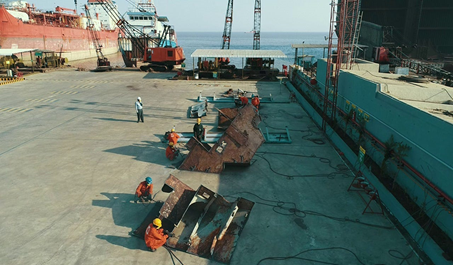
Bimco’s Chief Analyst, Niels Ramussen, reveals that low recycling
levels since 2021 has continued this year with only ten vessels recycled since
January. Container ships 20-years-old or more now make up 24% of the fleet, he
said, compared with 16% at the beginning of 2020. “As a result, we estimate that a recycling overhang of minimum 500
ships and 1.8 million teu now exists,” he declared. Historically, the Bimco analysis reveals that between 2000 and 2019,
20% of container ships were recycled before the age of 20, and 53% before they
reached 25. The combination of a strong market before the financial crisis
followed by a weaker market with more recycling makes the two-decade period a
good reflection of recycling during average market conditions, Rasmussen said.
However, there is currently a very large orderbook and extra capacity
is being absorbed by longer voyages to avoid the Red Sea as well as regulatory
requirements to improve efficiency. Recycling, therefore, could well run at a higher
level in the future. Therefore, Bimco
also used the recycling volumes of the weak market conditions prevailing in the
2010s, Rasmussen explained. Using this as a basis for calculation resulted in a
significantly higher overhang of 850 ships and 3.1 million teu. However, whether
the number of ships is at the low 500, the higher 850, or somewhere in between,
the implications for recycling yards are daunting. Rasmussen reveals that the
highest-ever annual recycling occurred in 2016 when 185 ships of 600,000 teu
were recycled.
“It is worth
noting that the estimated overhang is larger than the orderbook for ship
segments smaller than 8,000 teu,” he pointed out. “This may indicate that fleet
growth in the coming years will be driven exclusively by the larger ships
which, in turn, could drive further cascading of larger ships into routes where
smaller ships are currently deployed.”
The boxship overhang comes at a critical time for the recycling
sector. The long-awaited Hong Kong Convention came into force in June,
establishing rigorous new standards for the dismantling of ships. Most Indian
recycling facilities – an estimated 110 out of 120 – comply with the
Convention. However, few Bangladeshi yards comply, and not
a single Pakistani facility meets the Convention’s requirements.
The conclusion that must be drawn, therefore, is that a substantial
volume of additional recycling capacity is urgently needed.