
Office Address
123/A, Miranda City Likaoli Prikano, Dope
Phone Number
+0989 7876 9865 9
+(090) 8765 86543 85
Email Address
info@example.com
example.mail@hum.com


123/A, Miranda City Likaoli Prikano, Dope
+0989 7876 9865 9
+(090) 8765 86543 85
info@example.com
example.mail@hum.com
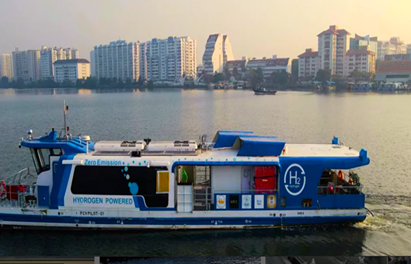
India marked a major step in
clean inland water transport on Thursday with the launch of its first
indigenously developed hydrogen fuel-cell vessel in Varanasi. Union Minister
for Ports, Shipping and Waterways Sarbananda Sonowal flagged off the vessel at
Namo Ghat, formally commencing its commercial operations.Describing the launch as a
landmark moment, Sonowal said the
hydrogen-powered craft underscores India’s advancing technological capabilities
and its commitment to sustainable and homegrown solutions. He noted that
with this development, India joins a select group of countries—including China,
Norway, the Netherlands and Japan—that have operational hydrogen-powered
vessels.
“This
achievement reflects our readiness for future technologies and our steady transition
towards green energy,” the minister said, adding that the progress has been
driven by the Prime Minister’s focus on sustainability and rapid infrastructure
development. He also highlighted the growing role of inland waterways in
India’s overall transport and logistics framework.
Several Union and state
ministers and local representatives attended the event in Varanasi, which is
also Prime Minister Narendra Modi’s parliamentary constituency.
Sonowal said hydrogen
propulsion, while still evolving, offers significant promise as a
near-zero-emission energy source and represents an important pillar of India’s
clean mobility strategy. Ongoing research and testing, he added, will help
scale the technology for wider commercial use...He credited the Jal Marg Vikas
Project for laying the groundwork for this transformation, particularly through
the development of a modern navigation corridor on National Waterway-1 between
Haldia and Varanasi, supported by multimodal terminals, upgraded navigation
systems and community jetties.
An
official statement said the hydrogen vessel initiative forms part of a broader
modernisation drive of inland waterways led by the central government and the
Inland Waterways Authority of India (IWAI).
Measures such as expanding navigable channels, commissioning modern terminals,
and introducing new passenger and cargo services are aimed at promoting cleaner
transport, improving connectivity and lowering logistics costs.
These
initiatives are aligned with national roadmaps including the Maritime India
Vision 2030 and the Maritime Amrit Kaal Vision 2047, which envisage greener
fuels, smarter infrastructure and a greater role for inland waterways in
India’s long-term development strategy.