




Office Address
123/A, Miranda City Likaoli Prikano, Dope
Phone Number
+0989 7876 9865 9
+(090) 8765 86543 85
Email Address
info@example.com
example.mail@hum.com


123/A, Miranda City Likaoli Prikano, Dope
+0989 7876 9865 9
+(090) 8765 86543 85
info@example.com
example.mail@hum.com
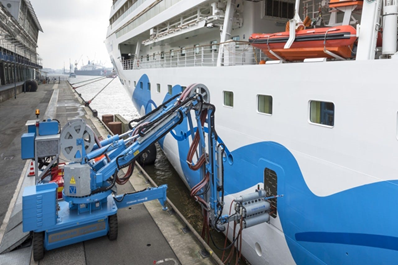
Mutual insurer TT Club has warned that a
smooth adoption of on-shore power supply connections will require early
co-operation between multiple stakeholders in and outside of ports in order to
prepare the detailed, long-term plans necessary to provide cold-ironing
services. The company raised time-consuming
processes including the potential need for electrical grid upgrades, risk
assessments, and financial planning before on-shore power projects get
underway.
The warning comes as a critical EU
deadline approaches under Regulation 2023/1804 on Alternative Fuels
Infrastructure, which mandates core ports in the Trans-European Transport
Network (TEN-T) use on-shore power supply from 2030, and requiring any EU port
with on-shore power supply capabilities to use the systems from 2035.
Harry Palmer, risk assessment manager at
TT Club, said: “cold ironing is not just a matter of installing plugs on the
quay; supplying far higher levels of steady power to multiple ships
simultaneously will require massive grid upgrades, large transformers and an
array of specialised connectors. We’re talking about building the energy and
risk management systems that will support the long-term sustainability of
maritime trade.”
On-shore power supply provides electricity to vessels at-berth,
allowing engines and generators to be turned off, cutting emissions in-port. By
switching off engines using traditional fuels in-port, greenhouse gas emissions
and emissions of pollutants such as particulates are dramatically reduced.
Despite the benefits of cold ironing and the looming EU deadline, TT
Club said that only around 20% of the on-shore power supply connections
required in Europe had been installed or contracted by mid-2025. Cruise
terminals were at around 38% of the target and container terminals at just 11%,
the club said.
“Port Authorities, port owners, terminal
operators and their technical and risk management teams have to start detailed
technical, financial and safety assessments now, and to involve all relevant
stakeholders early in the process,” said Palmer.
With substantial power requirements from
hotel loads, cruise ships lead demand for power in-port, followed by container
ships due to the power draw of reefer boxes.
In November 2025, the European Commission
announced funding to 24 European ports for electrification and deployment of
on-shore power supply, supporting a mix of projects to serve passenger and
cargo ships in Belgium, Denmark, Estonia, Spain, Finland, and France.
Investment commitments are rising; Italy has earmarked €700m for OPS projects,
and both the Netherlands and the UK have pledged several hundred million euros
each.
Although shipping companies are under
pressure to cut emissions, and on-shore power supply is a recognised method of
doing so, “high upfront costs and uncertain business models have slowed global
adoption. With new European rules coming into force and public scrutiny rising,
ports can no longer afford to wait,” said Palmer.