




Office Address
123/A, Miranda City Likaoli Prikano, Dope
Phone Number
+0989 7876 9865 9
+(090) 8765 86543 85
Email Address
info@example.com
example.mail@hum.com


123/A, Miranda City Likaoli Prikano, Dope
+0989 7876 9865 9
+(090) 8765 86543 85
info@example.com
example.mail@hum.com
President Trump has told an audience that
"there's another beautiful armada floating beautifully toward Iran right
now."
Some commentators have taken the president at his
word, and are interpreting a series of military movements towards the Middle
East as being indicative of an imminent US attack on Iran. However, close
examination of the movements which can be detected suggests these deployments
are precautionary, and far below the scale of what would be necessary to mount
an attack on Iran and to handle any Iranian response.
Prior to the recent upsurge in tension, US Central
Command has been supported by Arleigh Burke-class guided-missile destroyers
USS Mitscher (DDG-57) and USS McFaul (DDG-74),
and three Independence-class littoral combat ships optimized for mine
countermeasure missions, namely USS Tulsa (LCS-16) USS Canberra (LCS-30)
and USS Santa Barbara (LCS-32), with logistic support from
USNS Henry J Kaiser (T-AO-187).
On January 23, the
three Independence Class ships were alongside at the US Naval Support Facility
in Bahrain, and the four Avenger Class vessels they have replaced have now left
Bahrain.
In recent years it has been customary for this
permanent Central Command naval element to be supported in-theater by a US Navy
aircraft carrier with an accompanying carrier strike group. And if
operations are imminent, CENTCOM has in the past been supported by a second
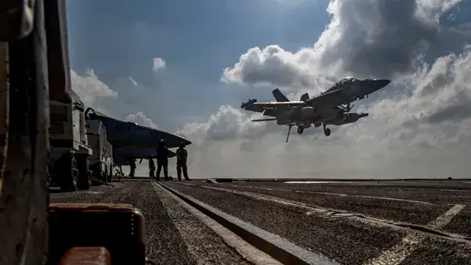
aircraft carrier. Hence the movement of the USS Abraham
Lincoln (CVN-72), with its Arleigh Burke Class guided-missile
destroyers USS Spruance (DDG-111), USS Michael
Murphy (DDG-112) and USS Frank E. Petersen Jr. (DDG-121),
with logistics support from USNS Carl Brashear (T-AKE-7),
restores the naval forces available to Commander CENTCOM to a normal contingency
level, but not to a level yet able to launch a pre-emptive US attack on
Iran.
A pre-emptive attack, which would likely provoke an
Iranian and Houthi ballistic missile response and counter-attacks on US bases
in the region, would need to be undertaken at a much greater scale if it were
to suppress the predictable response, involving at least a second US aircraft
carrier and major forward deployment of air assets.
Some air assets have been moved into theater, but
potentially are covering the increased tension in Syria, and with most cargo
aircraft flying from locations which suggest they are moving additional air
defense assets to the Middle East. Bolstering air defense is also the most
likely explanation for the deployment of a small RAF air defense half-squadron
to Qatar.
Cloud cover has been heavy for several days over
the airfield at Diego Garcia, but a break on Monday and a partial view Tuesday
January 27 showed the South Apron as empty of aircraft (above).
The CENTCOM air exercise planned this week is posted as being a rehearsal of alert measures, to ‘validate procedures for rapid movement of personnel and aircraft’ and to ‘practice’ dispersed operations at contingency locations’, should there be indications of an imminent Iranian ballistic missile attack on forward bases in the region. Such an exercise is probably necessary to improve the flow of such an emergency evacuation, given accounts of the chaos at recipient airfields in the region when a similar procedure was carried out prior to the Iranian attack on Al Udeid last summer.