

Office Address
123/A, Miranda City Likaoli Prikano, Dope
Phone Number
+0989 7876 9865 9
+(090) 8765 86543 85
Email Address
info@example.com
example.mail@hum.com


123/A, Miranda City Likaoli Prikano, Dope
+0989 7876 9865 9
+(090) 8765 86543 85
info@example.com
example.mail@hum.com
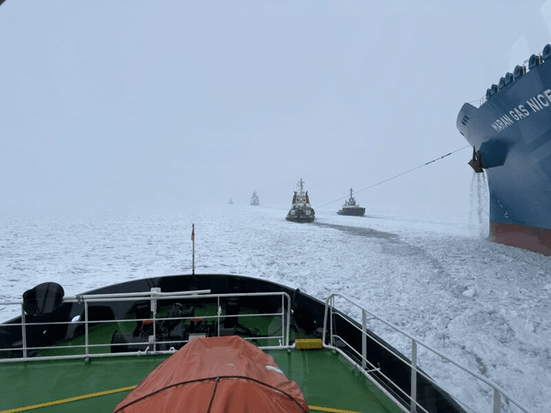
Operations at the floating LNG import facility Mukran off the Baltic coast of Germany resumed this
week after icebreaking efforts by the multipurpose vessel Neuwerk restored
access to open water following weeks of disruption caused by heavy sea ice in
the bay off Mukran.
The channel-clearing work came after Neuwerk itself
suffered a technical fault last weekend that forced the ship back to port for
repairs. Tug VB Bremen Fighter was then used to continue
opening a navigable corridor through accumulated ice, allowing LNG traffic to
resume at the Mukran LNG terminal.
Satellite imagery had shown dense sea ice covering
the bay in recent weeks with no open channel available, leaving LNG
carrier Maran Gas Nice unable to depart the terminal since
late January. AIS tracking indicates the vessel finally cleared Mukran on
February 11 once an initial path was opened.
Another LNG carrier, Minerva Amorgos,
had been waiting offshore since February 3. According to the German regulator
Wasserstraßen- und SchifffahrtsamtOstsee (WSA), the ship is expected to be
escorted into Mukran by the end of February 16, guided by terminal operator
Deutsche Regas.
Neuwerk, a German federal multipurpose vessel operated for
coastal protection, pollution response, and maritime safety, usually operates in the North Sea but was brought in to assist with ice breaking
in the Baltic Sea. The 78-meter ship is
equipped with reinforced hull plating and icebreaking capability, allowing it
to operate in moderate ice conditions. It is unclear when it can return to
service and currently remains in the port of Rostock.
With shipping halted, gas storage at Mukran fell to record lows, and the
facility reportedly stopped feeding gas into the national transmission system
in early February. Mukran has been a key import hub since Germany expanded LNG
infrastructure after the loss of Russian pipeline gas. It is Europe’s largest
floating storage and regasification unit (FSRU) terminal by throughput,
receiving roughly 12.9 TWh of gas equivalent in the past three months. January
alone saw about 4.4 TWh, though February volumes are expected to be sharply
lower because of the ice disruption.