


Office Address
123/A, Miranda City Likaoli Prikano, Dope
Phone Number
+0989 7876 9865 9
+(090) 8765 86543 85
Email Address
info@example.com
example.mail@hum.com


123/A, Miranda City Likaoli Prikano, Dope
+0989 7876 9865 9
+(090) 8765 86543 85
info@example.com
example.mail@hum.com
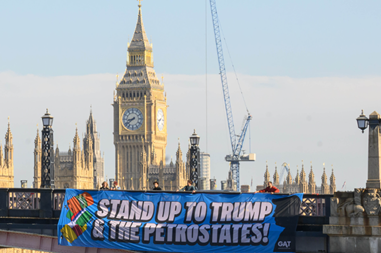
The outcome of
these talks will determine not just how shipping decarbonizes, but whether
billions in revenue are directed to the countries most affected by climate
breakdown. Vulnerable nations—who did the least to cause the crisis but face
its worst impacts—stand to benefit most. The
message was unmissable for all delegate and passersby. Like London’s iconic
“Mind the Gap” signs, the message is clear and directive: Stand up to Trump and
the petrostates. Deliver green shipping now. Positioned directly along the
route into the talks and dominating the riverfront skyline, the action was
designed to ensure that every delegate enters the building under public
scrutiny at a defining moment for global climate policy. Em
Fenton, Senior Director of Climate Diplomacy, at Opportunity Green
stated: “The IMO Net-Zero
Framework is not just a climate measure – it’s a test of whether international
cooperation can survive in an era of increasing geopolitical pressure. A
majority of the world’s nations want this to succeed. Opposition may be loud,
but that doesn’t mean it will drown out the voices for ambition and justice,
many of whom come from communities most greatly affected by climate impacts.”
Andrew Nazdin,
Director of Glasgow Actions Team, stated: “The only
beneficiaries of Trump’s foreign policy of chaos are the same oil executives he
invited to Mar-a-Lago for fundraising dinners — and the rest of us are stuck
with instability, war, and price spikes. Countries like Greece and Cyprus need
to decide if they really want to align themselves with Trump and the other
petrostates, or if they’re ready to say ‘enough is enough.’”
International
maritime shipping emits about one billion tons of carbon dioxide
per year—almost three times as much as the yearly
emissions from the United Kingdom as a whole. Yet this sector has escaped serious regulation for decades. Now, after
years of delay, the IMO is taking steps to adopt a global carbon levy.
The Net Zero
Framework (NZF), already negotiated and backed by a majority of countries,
would introduce the world’s first global carbon price on shipping. But after
being delayed last year amid political pressure, it now faces a critical
inflection point: it can move forward—or be weakened or abandoned entirely.
Over 60 countries support the measure, particularly
climate-vulnerable nations who stand to benefit if revenues are directed toward
climate finance and adaptation. Yet some
major shipping powers, including Greece—the owner of the world’s largest
commercial fleet—and Cyprus, are now distancing themselves from the broader
European position in favor of delay or dilution. Critics warn this risks
undermining both European leadership and global momentum.
Environmental
leaders have also criticized this retreat. Ahead of the IMO meeting, WWF Greece CEO Demetres Karavellas warned
that opposing the framework at this moment is “inconsistent with the leadership role that Greek
shipping has long claimed for itself.”
Fenton added: “We must remember that what happens at
these IMO meetings matters far beyond the shipping industry. It will determine
whether billions of dollars in revenue reaches the countries, communities, and
zero-emission technology projects that need it most, accelerating an equitable
transition for all.” If approved, this
levy could generate tens of billions annually. Vulnerable nations, which did
the least to cause the climate crisis but suffer its worst effects, would benefit
the most—through funding for adaptation, resilience, and a just transition—if
it’s treated as climate finance, not just reinvested in the shipping industry.
Data show a levy is the cheapest way to drive the sector’s energy transition,
and help shield the poorest and most vulnerable economies from its
impacts–provided that the revenues are invested strategically, with careful
attention to ensuring it’s implemented equitably. Spokespeople
from a variety of social and global movements spanning the issues of climate,
development, and international debt will be available for interviews throughout
the week.