



Office Address
123/A, Miranda City Likaoli Prikano, Dope
Phone Number
+0989 7876 9865 9
+(090) 8765 86543 85
Email Address
info@example.com
example.mail@hum.com


123/A, Miranda City Likaoli Prikano, Dope
+0989 7876 9865 9
+(090) 8765 86543 85
info@example.com
example.mail@hum.com
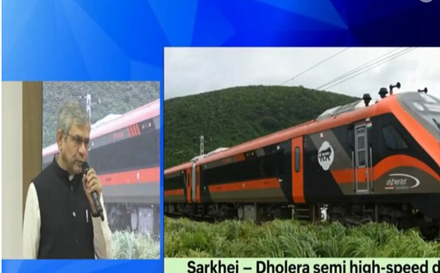
The project, spearheaded by the Ministry of Railways,
marks a historic milestone as Indian
Railways’ first-ever semi high-speed rail corridor planned with indigenously
developed technology. The transformative initiative is expected
to become a model project for the phased expansion of semi high-speed rail
connectivity across India. The proposed 134-kilometre double-line corridor in
Gujarat will significantly strengthen connectivity between Ahmedabad, the
rapidly developing
Dholera Special Investment Region (SIR), the upcoming Dholera
International Airport, and the prestigious Lothal National Maritime Heritage Complex.
The project is expected to provide a major boost to passenger mobility,
industrial growth, logistics efficiency, and regional economic development. Officials stated that the semi high-speed
rail corridor will drastically reduce travel time between Ahmedabad and
Dholera, enabling smooth daily commuting and facilitating same-day return
travel. The enhanced rail infrastructure is also expected to bring people and
businesses across wider regions closer through faster and more reliable
transportation. The project has been conceptualized under the PM-Gati Shakti National Master Plan
with a strong emphasis on integrated multi-modal connectivity,
seamless logistics movement, and coordinated infrastructure planning. The new
rail line is expected to improve mobility for both passengers and freight while
enhancing operational efficiency and service reliability for Indian Railways.
The Ahmedabad–Dholera rail corridor will directly
benefit nearly 284 villages with a combined population of around five lakh
people. Apart from boosting accessibility, the project is expected to generate
substantial employment and self-employment opportunities, contributing to the
vision of an
“Atmanirbhar Bharat” through comprehensive regional
development. Industry experts believe
the project will play a pivotal role in supporting the rapid industrialization
of Dholera SIR, which is emerging as one of India’s most significant smart
industrial cities and investment destinations.
The environmentally
sustainable rail project is also expected to contribute significantly towards
India’s climate goals. According to official estimates, the project will help
reduce oil imports by approximately 0.48 crore litres and lower carbon dioxide
emissions by nearly 2 crore kilograms annually — equivalent to planting around
10 lakh trees. With the approval of this pioneering project, India takes a major step
forward in developing next-generation rail infrastructure that combines speed,
sustainability, indigenous innovation, and economic growth, further
strengthening Gujarat’s position as a key hub in the nation’s infrastructure
and logistics landscape.