



Office Address
123/A, Miranda City Likaoli Prikano, Dope
Phone Number
+0989 7876 9865 9
+(090) 8765 86543 85
Email Address
info@example.com
example.mail@hum.com


123/A, Miranda City Likaoli Prikano, Dope
+0989 7876 9865 9
+(090) 8765 86543 85
info@example.com
example.mail@hum.com
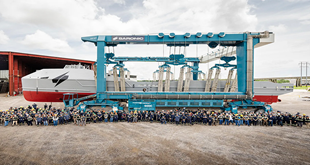
With expanded capacity
on track to be completed by the end of 2026, Saronic’s Franklin, Louisiaana, shipyard will be capable of producing up to 20 Marauders per
year. That production rate, the
company says, is what turns autonomous ships from a prototype into a program
—something that the Navy’s 2027 Shipbuilding Plan calls for,. “I’m incredibly proud of our team for
achieving this milestone. Designing, building, and launching an entire new
class of ships in under a year is a feat the American shipbuilding industry
hasn’t seen in generations,” said Dino Mavrookas, co-founder and CEO of
Saronic. “It’s what happens when design, production, and manufacturing are
fully integrated under one roof. With multiple hulls already underway and our
shipyard continuing to grow, this is what revitalizing American shipbuilding
actually looks like — autonomous ships delivered at speed and scale, with the
production capacity to back it up.”
Designed to deliver dual-use autonomous capability
for a range of defense and commercial applications, Marauder is built for the
kinds of sustained, long-range missions that place the greatest demands on any
maritime vessel and present the greatest risks to any crew. Operating fully
autonomously or under remote human supervision, Marauder is designed to operate
far from shore, for extended periods, without the additional stresses and
complexities of supporting a full crew or putting them in harm’s way.
With a top speed of
25+ knots and a range of up to 5,400 nautical miles, says Saronic. Marauder can
reposition rapidly and sustain operations across vast ocean distances. Its
150-metric-ton payload capacity, configurable to accommodate up to four 40-foot
or eight 20-foot ISO containers, enabling operatorsto tailor the vessel’s
mission load to varied needs, including logistics, research, maritime domain
awareness, persistent intelligence, surveillance, and reconnaissance (ISR),
without modifying the platform itself. Saronic says this modularity across
applications is critical to serve a broad base of customers who need a vessel
that can adapt as mission requirements evolve. Marauder addresses a core challenge:
delivering persistent, autonomous capability at scale, on a timeline that makes
real fleet integration possible. With expanded capacity on track to be
completed by the end of 2026, Saronic’s Franklin, Louisiaana, shipyard will be
capable of producing up to 20 Marauders per year. That production rate is what
turns autonomous ships from a prototype into a program. The speed of Marauder’s build is the result of a disciplined production
approach Saronic has been proving out at its Franklin, Louisiana shipyard.
Rather than separate design, manufacturing, and autonomy development across
different organizations and timelines, Saronic operates all three in-house,
enabling tighter iteration, faster decision making and compounding improvements
for each hull, supported by a resilient supply chain and strategic use of
commercial components that support rapid production. That approach, says the company, is built
on modern aluminum shipbuilding techniques, which includes subassemblies
designed for manufacturing speed, optimized production sequencing, and modular
construction methods that allow the team to move quickly without sacrificing
quality or repeatability.
This approach is allowing Saronic to deliver at speed
and scale. At the Franklin shipyard, the second Marauder hull was flipped in
March 2026 and is now being outfitted with mechanical, electrical, and autonomy
systems. The third and fourth hulls are under construction. Each one
demonstrates that Saronic’s production model is a repeatable system designed to
build fleets versus one-off prototypes.
Alongside development
of Marauder’s hardware, Saronic has developed a software-based fleet
intelligence platform that gives operators human-on-the-loop visibility into
the ship’s internal autonomous operations in real time. Marauder is the first
of its kind, a ship designed and built end-to-end for autonomy. This means that
every hardware component has a software interface for monitoring,
observability, and actuation. The
platform shows telemetry, vessel state, and subsystem status continuously, with
alerting, logging, and historical data replay for diagnostics and forensics,
and allows operators to intervene remotely in onboard autonomous processes from
any anywhere. As Marauder’s autonomy
systems mature and the fleet grows, says Saronic, this intelligence platform
will keep that complexity transparent, auditable, and under operator control —
and will continue to evolve as the mission demands.