


Office Address
123/A, Miranda City Likaoli Prikano, Dope
Phone Number
+0989 7876 9865 9
+(090) 8765 86543 85
Email Address
info@example.com
example.mail@hum.com


123/A, Miranda City Likaoli Prikano, Dope
+0989 7876 9865 9
+(090) 8765 86543 85
info@example.com
example.mail@hum.com
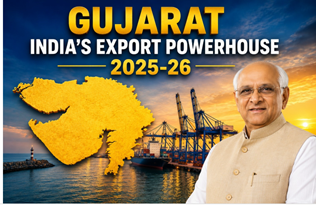
According to data released by the Directorate General of Foreign Trade
(DGFT), Gujarat recorded exports worth USD 110.63 billion
during the fiscal year, accounting for 25.6
percent of India’s total exports. The state maintained a
significant lead over other exporting regions, with Maharashtra securing the
second position with exports of approximately USD 70 billion. While Gujarat
continued to dominate the national export landscape, the state witnessed a 4.9
percent year-on-year decline in export value compared to FY 2024-25. The
moderation was largely attributed to evolving global trade dynamics,
tariff-related pressures in major overseas markets, and softer prices of key
export commodities. Industry observers noted that stable crude oil prices and
the prolonged weakness in global diamond markets impacted the overall export
valuation, particularly in sectors that traditionally contribute significantly
to Gujarat’s export basket.
Gujarat’s sustained
leadership is widely credited to its robust industrial base, world-class
infrastructure, extensive port network, business-friendly policies, and strong
entrepreneurial culture. These structural advantages have enabled the state to
remain a preferred manufacturing and export hub for a wide range of industries.
The state’s export performance continues to be
anchored by its petroleum and petrochemical sectors. Jamnagar retained
its status as Gujarat’s largest exporting district, followed by Ahmedabad, Surat, and Kutch,
reflecting the importance of refining, manufacturing, and port-led economic
activities in driving outbound trade. Apart from petroleum products, Gujarat
has built a diversified export portfolio that includes pharmaceuticals, organic
chemicals, agrochemicals, ceramics, iron and steel products, textiles, plastics,
pearls, and semi-precious stones. Experts highlight that the state’s extensive
refining capacity, coupled with the growth of petrochemical clusters in
industrial regions such as Dahej and Vadodara, has helped create a strong
downstream manufacturing ecosystem. These developments have significantly
enhanced Gujarat’s ability to produce value-added products and cater to global
demand.
The expansion of
industrial clusters and export-oriented manufacturing has also enabled Gujarat
to strengthen its presence across international markets, particularly in
Southeast Asia, Africa, and the Middle East. The state’s chemical,
pharmaceutical, textile, and plastics industries continue to gain traction in
these regions, contributing to a more balanced and diversified export profile.
Despite headwinds arising from tariff barriers in
certain key markets, exporters benefited from improved competitiveness due to
currency movements during the year. Industry stakeholders believe that
Gujarat’s strong infrastructure, strategic coastal location, and diversified
industrial ecosystem will continue to support its export growth trajectory in
the coming years. As India seeks to expand its footprint in global trade,
Gujarat’s continued dominance underscores the critical role of integrated
manufacturing, efficient logistics, and policy-driven industrial development in
enhancing the country’s export competitiveness.