




Office Address
123/A, Miranda City Likaoli Prikano, Dope
Phone Number
+0989 7876 9865 9
+(090) 8765 86543 85
Email Address
info@example.com
example.mail@hum.com


123/A, Miranda City Likaoli Prikano, Dope
+0989 7876 9865 9
+(090) 8765 86543 85
info@example.com
example.mail@hum.com
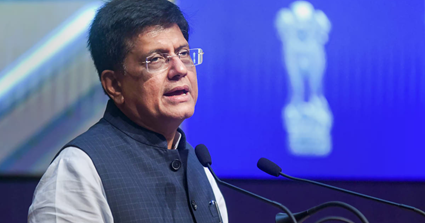
Addressing the launch event,
Goyal outlined a competitive framework under which states will be invited to
submit detailed project proposals highlighting their industrial strengths, land
availability, investor interest and sectoral potential. The government, he
said, would work closely with industry to identify suitable sectors and
infrastructure requirements for each location—spanning chemicals,
manufacturing, data centres and other industries—while ensuring parks are
designed to meet the specific needs of investors and sectors. The parks will be
developed in varying sizes to suit regional geographies: 25 acres in hilly
regions, smaller Union Territories and
northeastern states; 100 to 500 acres in mid-sized
states; and up to 1,000 acres in locations closer to cities and towns. Land
will be provided by state governments, while the central government will
support infrastructure creation through the National Industrial Corridor
Development Corporation (NICDC) in a 51:49 partnership model. The objective,
Goyal said, is to create plug-and-play industrial parks that are optimally
suited to their locations.
Each
park will be equipped with assured water and power supply, road and rail
connectivity, clear land titles, digital single-window clearances and, where
feasible, air connectivity. The minister also indicated that earmarked zones
for startups, deep-tech enterprises, R&D activities and innovation-led
businesses could be established within the parks, along with modern testing facilities
developed in partnership with the Bureau of Indian Standards (BIS), Export
Inspection Agency (EIA) and the Food Safety and Standards Authority of India
(FSSAI). Goyal further revealed that dedicated areas for Global Capability
Centres (GCCs), worker housing and social infrastructure are also being
considered, as are international enclaves developed in collaboration with
countries such as Japan, Singapore, the Republic of Korea and Switzerland. On
the rollout timeline, applications received between June 1 and July 31 will be
considered for the first phase covering 20 parks, with a further 30 parks to be
sanctioned based on proposals received by September 30. Subsequent phases will
be shaped by learnings from earlier rounds. Goyal said the ₹34,000 crore
central allocation is expected to catalyse substantially larger investments,
generate direct and indirect employment, and deepen Centre-State industrial
partnership.
Designated as the Project
Management Agency for BHAVYA, NICDC has developed the portal as a comprehensive
digital platform to support the full project lifecycle — from submission of
Detailed Project Reports and project appraisal to real-time implementation monitoring.
DPIIT Secretary Amardeep Singh Bhatia noted that robust digital systems are
essential for programme management at this scale, while NICDC CMD Rajat Kumar
Saini underscored the platform’s role in enabling efficient stakeholder
coordination and strengthening transparency.
The
launch followed Cabinet approval of the scheme, release of its operational
guidelines by DPIIT in May 2026, and prior consultations with states and Union
Territories. The event was attended by representatives of state governments,
industry associations, Export Promotion Councils, banks, master developers and
MSMEs, and was followed by a stakeholder interaction on industrial
infrastructure, logistics efficiency and India’s integration into global value
chains. Goyal framed BHAVYA as a cornerstone of the Viksit Bharat 2047 vision,
expressing confidence that the scheme would catalyse a new phase of industrial
growth and position India as a globally competitive manufacturing destination.