

Office Address
123/A, Miranda City Likaoli Prikano, Dope
Phone Number
+0989 7876 9865 9
+(090) 8765 86543 85
Email Address
info@example.com
example.mail@hum.com


123/A, Miranda City Likaoli Prikano, Dope
+0989 7876 9865 9
+(090) 8765 86543 85
info@example.com
example.mail@hum.com
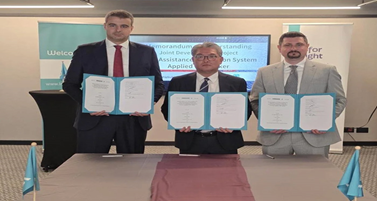
The project will
develop and optimize an MR tanker design with WAPS. The concept will
incorporate bound4blue’s eSAIL technology, which uses suction sail principles
to harness wind energy and deliver direct thrust, helping improve efficiency,
reducing fuel consumption and support compliance with tightening emissions regulations.
Under the agreement, the partners will carry out technical and regulatory
evaluation of the design, including assessments against the latest class rules
and IMO requirements. LR will provide technical assurance, design appraisal and
support the process towards Approval in Principle (AiP), while working closely
with LISCR on regulatory alignment. The collaboration is intended to reduce
uncertainty around the adoption of WAPS in the tanker market by validating
performance, safety and regulatory compliance at an early stage. By bringing
together expertise across design, technology, classification and flag, the
project establishes a structured pathway for future commercial deployment.
Alberto Pérez, head of Maritime Commercial Markets,
Lloyd’s Register: “This agreement reflects LR’s continued focus on
enabling maritime decarbonization through practical, scalable solutions. By
supporting the development of next-generation tanker designs, we are helping
shipowners and operators navigate the transition to lower-carbon operations
while maintaining commercial viability.”
“As demand for sustainable
shipping solutions continues to grow, this MoU will further strengthen our
capabilities in eco-friendly ship technology development and enhance our
competitiveness in the global MR tanker market,” said Tae-Hyun Koh, chief
technology officer, K Shipbuilding.
“We’re pleased to work with K Shipbuilding, Lloyd’s Register and the
Liberian Registry on this Joint Development Project,” said Daniel Mann, chief
commercial officer, bound4blue. “For shipyards, wind propulsion is becoming an
important part of future-ready vessel design, especially in segments such as MR
tankers. By bringing our experience and know-how to this Joint Development
Project, we can help define how the eSAIL system can be integrated into MR
tanker newbuild designs in a safe, practical and commercially competitive way.
It is a meaningful step in supporting the decarbonization of MR tankers, while
strengthening the role of practical, commercially viable technologies in the
future of shipping.”
Thomas Klenum, executive vice president, Liberian
Registry, said: “This project marks an important step in advancing
practical decarbonization for the tanker segment. Integrating wind-assisted
propulsion on MR tankers can reduce emissions while strengthening the
sustainability and competitiveness of global shipping, and thereby we are
helping to unlock immediate fuel savings and emissions reductions while
strengthening long-term regulatory compliance.”