



Office Address
123/A, Miranda City Likaoli Prikano, Dope
Phone Number
+0989 7876 9865 9
+(090) 8765 86543 85
Email Address
info@example.com
example.mail@hum.com


123/A, Miranda City Likaoli Prikano, Dope
+0989 7876 9865 9
+(090) 8765 86543 85
info@example.com
example.mail@hum.com
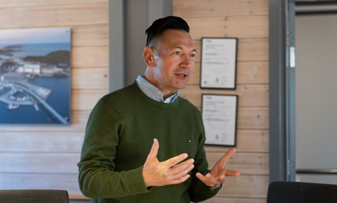
A master mariner with more than 30 years at sea across cargo ships,
ferries, and cruise vessels, Mihovilović founded ELNAV.AI to build practical AI
safety systems for bridge operations, with a focus on watchkeeping,
human-factor risk, and real-world deployment.In line with his company’s
mission, he sees the real breakthrough happening when shipping stops treating
AI as a feature label and starts treating it as part of a safety management
system. “That means clear limits, traceable outputs, proper change control,
degraded-mode behaviour, human-factors testing, and evidence from real
operating conditions,” Mihovilović says.
Shipping understands
that AI will matter, he tells Maritime CEO, but
says the governance around it is less developed, especially for safety-critical
AI, which can’t be just seen as software.
“That distinction matters. AI can
support safer watchkeeping, earlier risk recognition, fatigue-aware
intervention, and better learning from weak signals,” Mihovilović explains.
“But if AI is designed mainly for remote monitoring, scoring or
blame-by-replay, it can damage trust and weaken just culture.”
Mihovilović
tells Maritime CEO that his position is not anti-AI and
that he is more focused on a pro-safety, pro-seafarer view. “Shipping
should use AI where it improves safety and reduces harm. But we should resist
designs that quietly turn professional seafarers into data sources for remote
scoring and post-event blame. The principle I keep coming back to is simple:
assist the bridge, don’t audit it,” he states.
Shipping is already willing to pay for certain AI
solutions to alleviate pressure from fuel savings, emissions regulations,
insurance pressure, crew availability and regulatory complexity. However,
Mihovilović sees the industry as still being very pragmatic about it.
“Owners will pay when the business case is clear,
the operational burden is low, and the system does not create new problems for
the crew. The strongest case is not ‘buy AI because AI is modern’, the stronger
case is: reduce operational risk, reduce workload, improve compliance, preserve
professional competence and give management better evidence before something
goes wrong,” he says.
The ELNAV.AI founder admits a certain ‘fear of missing out’ factor being
present in AI spending, so he urges buyers to consider what problem it solves,
what evidence proves it works, what happens when it fails, and how the data is
governed before making a move.
“I would separate serious AI from weak AI claims with a few simple
questions. Where is the system meant to operate, and where is it not meant to
operate? What evidence exists beyond the sales deck? What happens in degraded
modes? Sensor loss, poor connectivity, bad input, bad weather, fatigue,
workload and unusual traffic are not edge details in shipping. They are normal
operational concerns,” he claims.
But that is not the only issue for Mihovilović. Another problem with
shipping-dedicated AI is the workforce that creates it.
“AI in shipping cannot be built only by software people. It also cannot
be evaluated properly by people who have never stood a watch,” he points out.
“The key skills are changing. We need people who understand navigation, bridge resource management,
human factors, data governance, cybersecurity and AI assurance.” As Mihovilović puts it, the valuable person is not only the one who can
build an AI model, but also the person who can ask whether the system will
still make sense at 3 am, in poor visibility, with a tired officer, a sensor
problem, and commercial pressure in the background.
When asked how technology, especially AI, will benefit the future of
shipping, Mihovilović says that AI will benefit shipping most when it reduces
risk without reducing professional responsibility. Areas such as decision
support, early warning, anomaly detection, predictive maintenance, environmental
protection, and administrative workload reduction, Mihovilović believes, are
where AI can help the most. He does
not, however, support shipping’s idea of using AI for autonomous vessels as its
“one single destination”.
“Coastal, inland, port and deep-sea operations are
very different. A system operating on a constrained route with nearby support
is not automatically evidence of crewless deep-sea operations. The future I see
is human-in-the-loop for a long time. That is not a weakness. It is a realistic
transition path.”
When a possible oversaturation of the shipping AI
market was discussed, he states that, in marketing language, that is the case.
However, in mature, evidence-backed, safety-governed AI for shipping, he still
sees the market as very young, and that those solutions currently revolve
around voyage optimisation, route-risk assessment, bridge situational
awareness, machinery monitoring, document processing, and shore-side decision
support.
In the years ahead, Mihovilović claims the most important applications
will sit at the intersection of safety, operations and assurance. “That includes bridge decision support,
collision-risk awareness, machinery anomaly detection, fatigue-aware safety
support, cyber-risk monitoring and tools that help companies learn from
near-misses without creating a blame culture,” he reveals to Maritime CEO.
And ultimately, according to Mihovilović, the long-term winners of the
shipping AI race will not be the systems with the loudest AI branding. They
will be systems that can demonstrate safety benefits, define their limits,
support human skill, and withstand scrutiny from crews, class, insurers, and
regulators.