




Office Address
123/A, Miranda City Likaoli Prikano, Dope
Phone Number
+0989 7876 9865 9
+(090) 8765 86543 85
Email Address
info@example.com
example.mail@hum.com


123/A, Miranda City Likaoli Prikano, Dope
+0989 7876 9865 9
+(090) 8765 86543 85
info@example.com
example.mail@hum.com
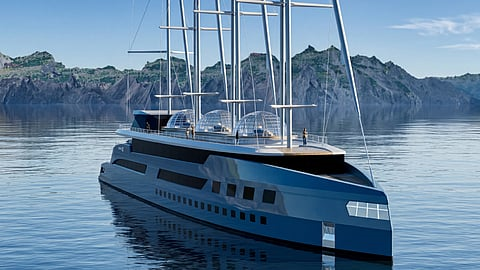
The vessel will have a length of 100 metres and
space for 32 guests and 32 crewmembers. Velarca said that at this size, the
vessel will operate more like a private platform for exploration than a
traditional expedition ship — prioritising space, time, and proximity to the
environment over volume and capacity.
Developed from a design brief
created by Velarca, the concept was realised in collaboration with Tim Ulrich
and the team at German yacht design firm Beiderbeck Designs. The hybrid propulsion architecture will
consist of three complementary operating modes: electric propulsion,
wind-assisted propulsion through Velarca's patented rig system, and
biodiesel-powered operation. In ports, fjords, and environmentally sensitive
areas, the vessel will operate on battery power alone. Underway, wind
propulsion will be utilised, while onboard systems will regenerate electrical
energy while under sail. Conventional
propulsion will meanwhile provide range and redundancy when required. The
vessel is designed for ice-class operations, enabling access to high-latitude
regions. Onboard spaces will include expansive social decks, a wellness suite,
an expedition hub, and a series of glazed observation domes positioned at the
upper deck level. These spaces are designed to offer uninterrupted engagement
with the surrounding environment, whether in Arctic conditions or open ocean
passage.