



Office Address
123/A, Miranda City Likaoli Prikano, Dope
Phone Number
+0989 7876 9865 9
+(090) 8765 86543 85
Email Address
info@example.com
example.mail@hum.com


123/A, Miranda City Likaoli Prikano, Dope
+0989 7876 9865 9
+(090) 8765 86543 85
info@example.com
example.mail@hum.com
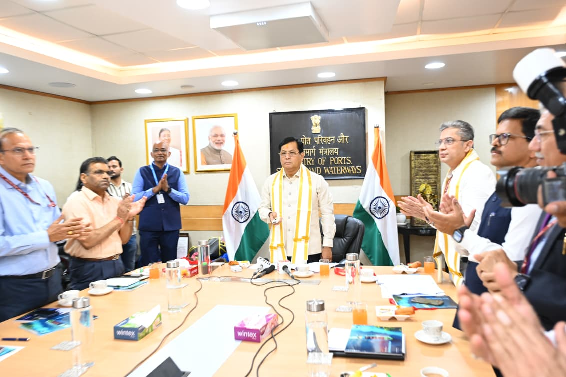
Dedicating a series
of sustainability, education and innovation initiatives at VOCPA, Sonowal
highlighted the findings of the port’s first Sustainability Report, which
revealed that renewable energy now offsets nearly 94% of the port’s
energy-consumption equivalent, while net carbon emissions have been reduced by
around 45%. The report also noted that carbon intensity per tonne of cargo has
been reduced by nearly half over the past four years, reinforcing VOC Port’s
position as a frontrunner in India’s green maritime transition. “VOC Port is demonstrating what can be
achieved when infrastructure development is guided by sustainability,
innovation and community welfare. The port’s achievement in reducing net carbon
emissions by 45% is a significant milestone in India’s journey towards greener
and more responsible maritime growth. These initiatives reflect the vision of
Prime Minister Narendra Modi for building modern, sustainable and future-ready
infrastructure while investing in people, technology and the environment,”
Sarbananda Sonowal said. A major highlight of the event was the
commencement of academic activities at Kendriya Vidyalaya, VOC Port, for the
2026-27 academic session. Established with the approval of Kendriya Vidyalaya
Sangathan, the institution will initially function from the Port School campus
and provide quality CBSE education to children of port employees, Central
government personnel and the local community. The initiative is expected to
strengthen educational infrastructure in Tuticorin while expanding access to
affordable, high-quality education. “Quality education is one of the most
powerful instruments of social transformation. The establishment of Kendriya
Vidyalaya at VOC Port will provide new opportunities for children and strengthen
the social infrastructure required for long-term development,” Sonowal said.
The Union Minister
also released the IIM
Calcutta case study, “The Hydrogen Pivot: Orchestrating the
Green Transition at V.O. Chidambaranar Port Authority,” which documents the
port’s transformation from a conventional cargo hub into a green energy and
sustainable maritime centre. The study highlights the port’s pioneering efforts
in renewable energy, electrification and green hydrogen development, including
India’s first green hydrogen pilot project commissioned at a major port.
Further reinforcing its environmental credentials, VOC
Port received recognition as a Scope-2 Emission Free Port, reflecting its
successful transition toward clean energy and low-carbon operations. The
certification validates the port’s decarbonisation efforts and strengthens its
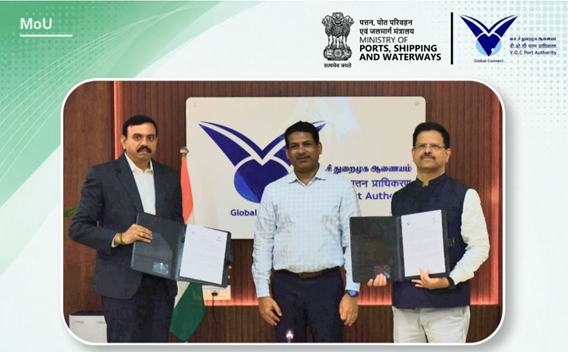
standing as one of India’s leading green ports. In another major development, VOC Port
Authority signed a Memorandum of Understanding with Gati Shakti
Vishwavidyalaya, Vadodara, to promote collaboration in research, innovation,
logistics education, skill development and sustainable port operations. The
partnership is expected to facilitate the establishment of a Centre of
Excellence in Maritime Logistics and Port Management while creating new
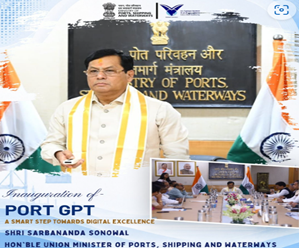
opportunities for industry-academia engagement. The minister also launched the PortGPT
mobile application, making VOC Port the first major port in India to extend an
enterprise-grade generative artificial intelligence platform through a
dedicated mobile application. The platform is expected to enhance operational
efficiency, knowledge management and data-driven decision-making while
supporting the port’s long-term digital transformation goals. Vijay
Kumar, Secretary, MoPSW; Susanta Kumar Purohit, Chairperson of VOCPA, among other senior officials of the ministry and the
government were present at the event.