


Office Address
123/A, Miranda City Likaoli Prikano, Dope
Phone Number
+0989 7876 9865 9
+(090) 8765 86543 85
Email Address
info@example.com
example.mail@hum.com


123/A, Miranda City Likaoli Prikano, Dope
+0989 7876 9865 9
+(090) 8765 86543 85
info@example.com
example.mail@hum.com
Archipelago
Yachts and Chartwell Marine have successfully demonstrated a pioneering
methanol-powered range extension system, capable of delivering approximately 12
times the effective energy density of today's leading marine batteries, marking
a major step forward for zero-emission maritime transport.
The breakthrough comes following completion of the Innovate UK-funded
"Methanol Pathfinder UK" project, supported through the UK
Government's Clean Maritime Demonstration Competition (CMDC6) and UK SHORE
programme.
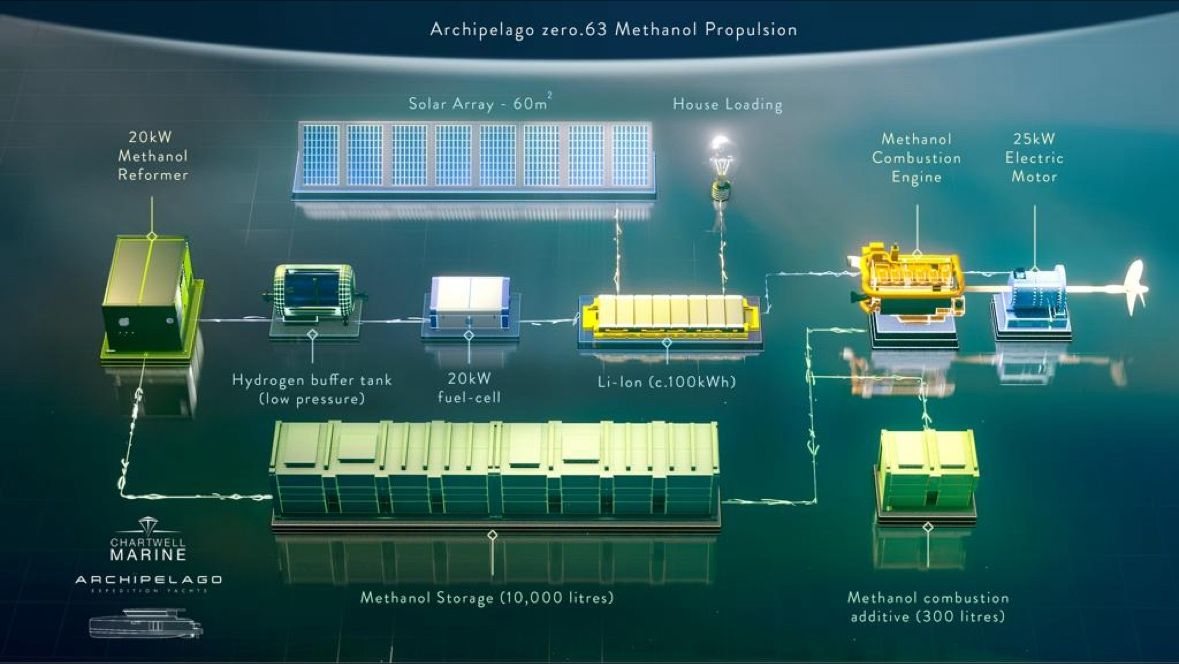
Developed and tested at Archipelago Yachts' Isle of Wight facility, the
prototype system successfully converted methanol into hydrogen and then
electricity using a fuel cell, creating a practical range extender for electric
vessels without the need for combustion engines.
Testing demonstrated an end-to-end energy conversion efficiency similar
to that of marine diesel engines. The resulting effective gravimetric energy
density of consumed methanol (approximately 1.5kWh/kg) is around 10-12 times
greater than the best marine lithium iron phosphate batteries currently
available.
The findings address one of the most significant challenges facing the
marine industry's transition to electric propulsion of energy storage.
Dr Stephen Weatherley, CEO of Archipelago Yachts, said: "The
results exceeded our expectations and provide real-world validation of a
technology that could fundamentally change how electric vessels are powered. We
have demonstrated that methanol can be converted into usable electrical energy
with sufficient efficiency to make it a viable range-extending solution for
vessels that would otherwise be constrained by battery capacity. Achieving an
effective energy density 12 times greater than marine batteries is a
significant milestone for the industry."
The project successfully integrated commercially available technologies
into a fully operational prototype, including an E1 Marine methanol reformer,
an Auriga Energy hydrogen fuel cell, a 100kW electric propulsion system and a
100kWh high-voltage battery installation.
The complete system was housed within a specially modified 20-foot
container, enabling the consortium to conduct extensive testing and collect
performance data under representative operating conditions.
Analysis conducted during the project suggests the technology could
reduce emissions by approximately 40 tonnes of CO₂ per vessel annually in
leisure vessel applications, with substantially greater savings possible in
commercial sectors such as offshore wind support vessels and crew transfer
vessels.
Andy Page, managing director of Chartwell Marine, said “One of the most
important outcomes is that we've generated hard performance data rather than
theoretical projections. The technology has now been physically built,
integrated and proven."
"The results demonstrate that methanol offers a realistic pathway
to overcoming the range limitations currently facing electric vessels. That
opens up significant opportunities across the leisure, commercial and offshore
sectors” he continued.