




Office Address
123/A, Miranda City Likaoli Prikano, Dope
Phone Number
+0989 7876 9865 9
+(090) 8765 86543 85
Email Address
info@example.com
example.mail@hum.com


123/A, Miranda City Likaoli Prikano, Dope
+0989 7876 9865 9
+(090) 8765 86543 85
info@example.com
example.mail@hum.com
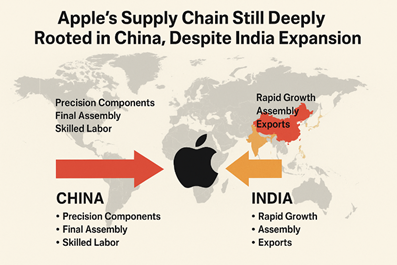
Despite a visible pivot to reduce dependence on China,
recent data reveals that the world’s second-largest economy remains the hub of
Apple’s most complex and high-value operations. According to the American Enterprise Institute (AEI), China currently
houses around 50% of Apple’s electronics manufacturing facilities, a decrease
from the 60–70% share prior to 2018. While this marks progress toward
diversification, China remains dominant in final assembly and component
manufacturing, especially for high-tech inputs like lithium-ion batteries,
printed circuit boards, and precision mechanical components…Even amidst
escalating geopolitical tensions and a steep 54% U.S. tariff on Chinese goods
in 2025, Apple continues to rely heavily on China’s industrial backbone. The
country’s integration into the Apple ecosystem is not merely logistical but
structural—its role in Apple’s
manufacturing is foundational. China is
not just a supply-side partner; it is a key market for Apple’s products. In
the December 2024 quarter, Greater China accounted for 17% of Apple’s global
revenue, underlining the strategic importance of maintaining strong
manufacturing and commercial ties with the region…Notably, about 37% of Apple’s 35 suppliers in Vietnam are either
Chinese or Hong Kong-based, illustrating how Apple’s international footprint is
still deeply anchored to Chinese expertise. Apple’s supply chain expansion into
India is real and growing fast. In the fiscal year ending March 2025, Apple
assembled $22 billion worth of iPhones in India—a 60% year-on-year increase.
India now produces approximately 14% of global iPhone output, up from just 3.1%
in 2021. During the same period, India exported $17.4 billion worth of iPhones,
highlighting its emergence as a key node in Apple’s global network. Apple and
its suppliers are aiming high: by 2026–27, they plan to produce 32% of the
world’s iPhones in India, with a production value reaching $34 billion…Despite Apple’s
diversification strategy, full decoupling from China is years away, if not
longer. The reasons are structural: Scale: China’s ecosystem supports hundreds of
thousands of workers; Foxconn’s Shenzhen complex alone employed over 500,000
workers in 2010. Infrastructure: China’s supply chain infrastructure, from rail
freight to port access, is deeply optimized for high-volume electronics
production. Automation & Quality Control: Apple’s strict quality standards
are harder to maintain in India, where recurring quality issues have already
impacted iPhone 16 production.
Even tariff policies don’t fully incentivize a shift. While the U.S. has imposed tariffs of 54% on China
and 26% on India, other countries like Vietnam face 46% tariffs, complicating a
complete transition of production from China to alternative markets.
Apple’s
diversification to India is both strategic and substantial, with iPhone output
growing significantly and export numbers rising sharply. But the data tells a
clear story: China remains the nerve center of Apple’s global supply chain,
especially in high-value, precision-driven manufacturing.
India’s rise in Apple’s ecosystem is promising, but
current limitations around quality, infrastructure, and self-sufficiency
suggest that China’s dominance will persist in the foreseeable future. For Apple, the path forward will be less about
decoupling and more about strategic hedging, balancing political risk, tariff
exposure, and operational efficiency across a multi-country supply chain that
still, unmistakably, leans on China.