

Office Address
123/A, Miranda City Likaoli Prikano, Dope
Phone Number
+0989 7876 9865 9
+(090) 8765 86543 85
Email Address
info@example.com
example.mail@hum.com


123/A, Miranda City Likaoli Prikano, Dope
+0989 7876 9865 9
+(090) 8765 86543 85
info@example.com
example.mail@hum.com
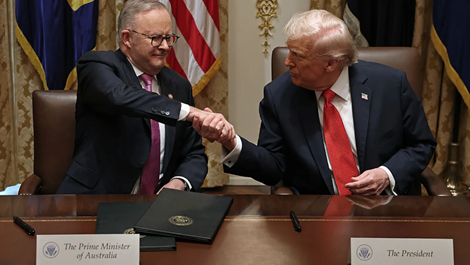
The U.S. and Australia
launched a multi-billion-dollar initiative to build a supply chain for critical
minerals essential to their military and domestic industries.
U.S. President Donald
Trump and Australia Prime Minister Anthony Albanese signed on Monday (20 Oct) a non-binding framework for collaboration that includes joint public and private investments
in the mining and processing of critical minerals. The accord also pledges to streamline or deregulate permitting for
mineral extraction and refining, and commits to adopting price floors or
similar measures to shield domestic markets from unfair trade policies.
“We’ve been working on
that for quite a while,” Trump said of the cooperation agreement in a White
House signing ceremony with Albanese.
“In about a year from now, we’ll have so much critical mineral and rare earths
that you won’t know what to do with them.”
The U.S. and Australia plan to provide at
least $1 billion in financing for critical mineral projects in each country
within six months, according to the framework document. At the signing,
Albanese said part of the deal includes an $8.5 billion pipeline, but did not
provide details.
Building an independent critical mineral supply
chain has become more urgent for the U.S. as trade rival China tightens
export restrictions on goods and technology related to rare earths, a
critical mineral classification. China is the world’s top producer of essential minerals, according to the U.S. Geological Survey, and a major buyer of Australia’s strategic minerals, including 95% of the country’s lithium ore
spodumene.
China’s threat to the
U.S. and global markets goes beyond slowing exports. In 2024, the country’s
overseas mining acquisitions reached the highest level in a decade, critical
mineral experts at the Center for Strategic and International Studies said in an analysis of the framework. “A key obstacle to minerals security is China’s deliberate manipulation
of global markets—flooding them with excess supply to push prices so low that
mines in countries like the United States and Australia become unviable,” the
assessment said. “This approach has made it difficult for the United States and
its allies to compete with China under current market conditions.” Australia is an “indispensable partner”
to the U.S. because it contains over 40 minerals identified as critical by the
USGS, the analysis said.
The framework includes
the countries mobilizing the government and private sector for capital and
operational expenditures through guarantees, loans or equity.
On Monday, the U.S. Export-Import Bank said it had issued Letters of Interest totaling more than $2.2 billion to seven
companies engaged in critical or strategic minerals production and processing
in Australia. The companies are Arafura Rare Earths, Northern Minerals,
Graphinex, Latrobe Magnesium, VHM, RZ Resources and Sunrise Energy Metals. A Letter of Interest is a non-binding
preliminary indication that the Export-Import Bank is willing to consider
financing a proposed export transaction.
The outline for
cooperation between the U.S. and Australia also commits the parties to
developing new or existing authorities and diplomatic tools for reviewing and
deterring critical mineral and rare earth sales on national security grounds. Other
provisions include a joint security response group to address supply chain
risks and identify priority minerals, and a pledge to invest in mineral
recycling technologies.