

Office Address
123/A, Miranda City Likaoli Prikano, Dope
Phone Number
+0989 7876 9865 9
+(090) 8765 86543 85
Email Address
info@example.com
example.mail@hum.com


123/A, Miranda City Likaoli Prikano, Dope
+0989 7876 9865 9
+(090) 8765 86543 85
info@example.com
example.mail@hum.com
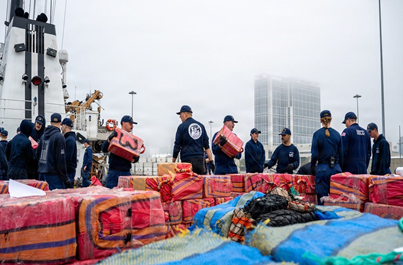
Criminal
gangs have infiltrated maritime supply chains and now operate legitimate
forwarding businesses that also move significant amounts of illegal drugs
Bin Laden’s freight forwarder led the way in
terms of shipping illegal goods, according to a former Federal Maritime Commissioner who himself admits to
smuggling wine from Italy to his home in Washington. When
regulators break the law with ease you know there is a security problem.
Carl Bentzel, once of the Federal Maritime Commission, but more recently the
President of the National Association of Waterfront Employers (NAWE), recounted
his limited criminal past, smuggling wine into the US, to prove to congress
the how open the freight system is.
Bentzel had all the shipment
information on wine shipped, legally, from his honeymoon in Italy, after
telling Congress that he could beat the maritime security system easily.. The
shipped ‘olive oil’ was delivered to his house, four blocks from the US
Capitol, “Perhaps the most protected terrain in the United States,” and it
arrived intact, not a bottle was broken, he said. According to Bentzel: “If I can't [as a
drug smuggler] come up with a credible way of lying my way through the system,
I'm a total idiot… It wouldn't take that much to buy your own little freight
forwarding operation.” He said, “That's what Osama bin Laden did.”
Bin Laden operated a
honey trading business with around 18 vessels, it was a legitimate business
that also carried illicit cargoes…The failure of the maritime industry and
regulators to develop a more effective system of inspecting cargo containers
means that the drug smugglers, realistically, have an open goal.
One of the reasons for
this move was the World Customs Organization study (WCO), released in June, in
which it was found that 70% of maritime drug seizures had a trusted insider
link…According to the WCO study, there were 2,600 drug
seizures, totalling 1,347 tonnes of cocaine, 97% of the total that was
confiscated in 2023-2024, and 70% of
these incidents had a “trusted insider” helping the smugglers
US law firm Holland
& Knight said the Maritime Drug Law Enforcement Act (MDLEA) is the primary
law that prohibits the illegal transportation of drugs on a vessel. “In tandem
with USCG [US Coast Guard] law enforcement efforts under the
MDLEA, the recently imposed Trump Administration counter-narcoterrorism
policies have resulted in a shift by traffickers from using traditional small
‘go-fast’ drug-running vessels to a critical part of the global supply chain:
commercial vessels plying their trade on the high seas,” said a Holland &
Knight paper on drug running on commercial vessels.
The challenge for the
maritime industry and for regulators now is how to monitor the movement of more
than 200 million containers a year, when, as Bentzel points out, they are
packed in places where the drugs originate and not in the destination
jurisdictions. Moreover, the only information on
the contents of a box is what the people that packed it tell you is in it. Just as Bentzel demonstrated with his cargo
of wine designated as olive oil.
The maritime industry
has an incentive to co-operate with authorities on this issue, because as
Holland & Knight point out, “Discovery of drugs onboard a commercial vessel
introduces significant legal risk to vessel owners, operators, crew, shippers
and insurers. It can trigger immediate vessel and crew detention, which can be
lengthy and extremely costly for vessel owners.”