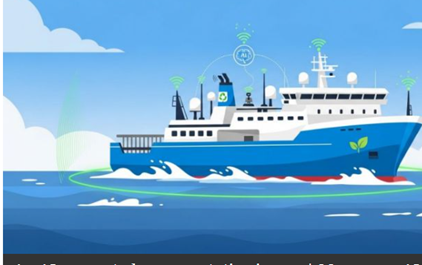
The zero-discharge vessel: The rise of self-correcting sewage treatment
For decades, the maritime industry has operated
under a "treat and release" mindset. As long as onboard systems met
the basic MARPOL Annex IV standards, effluent was discharged into the grey-blue
expanse of the high seas.
However, as
environmental regulations tighten and "Special Areas" (SAs) expand,
the margin for error has vanished. The industry is now moving toward the
Zero-Discharge Vessel. At the heart of this revolution is the marriage of
Artificial Intelligence (AI) and the Internet of Things (IoT), turning passive,
mechanical Sewage Treatment Plants (STPs) into "self-correcting"
ecosystems capable of adjusting to the volatile biological loads of a working
ship.
Traditional
onboard sewage treatment is often a "dumb" process. Systems are
typically calibrated for a steady state—a specific number of crew members
producing a predictable amount of waste. But
ships are dynamic. A cruise ship’s load spikes during gala nights; a cargo
vessel’s load shifts during crew changes or port stays.
When the
biological load (the concentration of organic matter) spikes, traditional
systems often underdose chemicals or provide insufficient aeration, leading to
non-compliant discharge. Conversely, during low-load periods, systems often
over-dose, wasting expensive chemicals and potentially killing the
"good" bacteria required for biological treatment. This
"static" approach is the enemy of the modern ESG-compliant shipowner.
The
transformation begins with IoT integration. In a self-correcting plant, the
tank is no longer a silent steel box; it is a data-rich environment.IoT sensors
are deployed throughout the treatment chain to monitor critical parameters in
real-time:
Total
Suspended Solids (TSS) & Turbidity: Optical sensors measure the clarity of
the water.
→
Oxidation-Reduction Potential (ORP) & Dissolved Oxygen (DO): These sensors
monitor the health of the aerobic bacteria breaking down the waste. → Flow Rate Meters: Tracking the volume of
influent to predict hydraulic surges →
Ammonia and Nitrate Sensors: Measuring the chemical breakdown of nitrogenous
waste.
These
sensors act as the nervous system, transmitting data via internal shipboard
networks to a centralised processing unit. This constant stream of data
replaces the "daily manual test," which is often prone to human error
and only provides a snapshot in time. The
true "Zero-Discharge" capability emerges when AI and IoT control the
mechanical actuators of the ship. This is a "closed-loop" system
where the software directly manages:Variable Frequency Drives (VFDs): To speed
up or slow down aeration blowers based on oxygen demand.→ Peristaltic Dosing
Pumps: To inject precise milligrams of disinfectant. → Automated Recirculation
Valves: If the sensors detect that the effluent does not meet the 15ppm (parts
per million) or local port authority standards, the AI automatically closes the
overboard discharge valve and recirculates the water for a second treatment
cycle.
While AI and IoT manage the process, Blockchain manages the proof. For a vessel to be truly
"Zero-Discharge," it must prove its compliance to sceptical port
authorities.
Every time
the AI triggers a discharge or a recirculation event, a cryptographic
"fingerprint" of that data—including GPS location, time, and water
purity levels—can be uploaded to a private or consortium blockchain. This creates a "Digital Garbage
Record Book" that cannot be tampered with, deleted, or backdated. For
shipowners, this is the ultimate insurance against heavy fines and "magic
pipe" allegations. Economic and Environmental Impact
The move toward self-correcting plants isn’t just
about avoiding fines; it’s a powerful economic driver. → Chemical Savings: By dosing based on actual
need rather than maximum capacity, ships can reduce chemical consumption by
30-50%. → Extended Hardware Life:
AI-managed pumps and blowers run only when necessary, reducing mechanical wear
and extending the time between expensive dry-dock overhauls. → Crew Efficiency: Engineers are freed from
the tedious task of manual water testing and constant calibration, allowing
them to focus on high-value maintenance tasks.
→ Marine Preservation: By ensuring that every drop of water returned to
the ocean is purer than the surrounding sea, the maritime industry moves from
being a polluter to a steward of the "Blue Economy."
As we look toward the International Maritime
Organization’s (IMO) future targets, the "Zero-Discharge Vessel" will
become the industry standard rather than a luxury.
Related News