

Office Address
123/A, Miranda City Likaoli Prikano, Dope
Phone Number
+0989 7876 9865 9
+(090) 8765 86543 85
Email Address
info@example.com
example.mail@hum.com


123/A, Miranda City Likaoli Prikano, Dope
+0989 7876 9865 9
+(090) 8765 86543 85
info@example.com
example.mail@hum.com
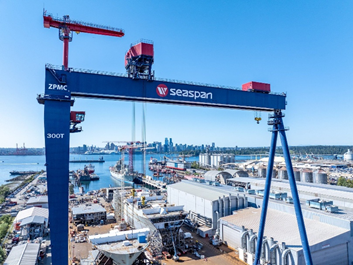
The company has
awarded a $1.5 million contract to Alberta’s Confined Space Robotics (CSR) to
develop semiautonomous robotic systems designed to handle blast and paint
operations across its ship and submarine programs. The investment, announced
February 12, signals a push to automate one of the most hazardous and
labor-intensive aspects of ship construction and maintenance.
The robotic platforms will carry specialized tools
including needle scalers, laser ablation systems, grinders, grit blasters, and
spray-coating equipment. Custom software will guide path planning and
operations, allowing the systems to work inside confined and high-risk spaces
where crews are traditionally exposed to toxic fumes, particulates, and
repetitive strain injuries.
For shipyards, blast
and paint work is essential but punishing. By shifting repetitive surface
preparation and coating tasks to robots, Seaspan aims to reduce worker exposure
and injury risk while improving consistency and material efficiency.
“We are incredibly
excited to partner with Seaspan to redefine what is possible in shipbuilding
through world-leading robotic technology,” said Ahmed Kawar, Director of
Engineering and Projects at CSR. He said the systems are designed to improve
safety while allowing skilled workers to focus on higher-value tasks.
Seaspan executives framed the move as part of a
broader industrial strategy tied to Canada’s National Shipbuilding Strategy.
“The National Shipbuilding Strategy is about more
than building ships; it is about building a sustainable, high-functioning
shipbuilding ecosystem,” said Dave Hargreaves, Seaspan’s Senior Vice President
of Strategy, Business Development and Communications. He noted the partnership
will expand Seaspan’s supply chain into Alberta while supporting workplace
safety and sustainability goals.
Seaspan employs
roughly 5,000 workers across facilities in North Vancouver and Victoria. The
yard is building vessels for both the Royal Canadian Navy and the Canadian
Coast Guard, with four ships delivered and three currently under construction
as part of a long-term commitment of up to 23 vessels.
Canadian Industry
Minister Mélanie Joly said the investment aligns with Ottawa’s push to expand
domestic advanced manufacturing. “This partnership between Seaspan Shipyards
and Alberta’s Confined Space Robotics shows how Canadian industry continues to
push the boundaries of advanced manufacturing,” she said.
The move also reflects
a broader shift across global shipbuilding. South Korea’s HD Hyundai has launched
humanoid welding robot initiatives in recent years through partnerships with robotics
firms in Germany and elsewhere, targeting labor shortages in welding. Seaspan’s
effort, however, focuses on blast and paint operations—an equally critical but
often overlooked bottleneck in both newbuild and repair work.
As shipyards worldwide
contend with skilled labor constraints, stricter safety standards, and
environmental compliance pressures, automation is moving from experimental to
practical. Seaspan’s robotics investment suggests North American yards are
beginning to follow that trend more aggressively.