

Office Address
123/A, Miranda City Likaoli Prikano, Dope
Phone Number
+0989 7876 9865 9
+(090) 8765 86543 85
Email Address
info@example.com
example.mail@hum.com


123/A, Miranda City Likaoli Prikano, Dope
+0989 7876 9865 9
+(090) 8765 86543 85
info@example.com
example.mail@hum.com
Roberta Weisbrod, WFSA
Executive Director said, “The specifications for the ferry made it almost
impossible—shallow waterways, pirates, and insufficient local shipbuilding
capacity, but 18 student teams from around the world, worked through the
obstacles and successfully submitted their completed designs.”
By way of background,
currently the Niger River, like the other inland waterways of central and
western Africa, have the world’s record for fatal ferry accidents. There
are strong reasons, however, has confidence for improvement. The State of Lagos
recently mounted a new safe ferry system for the city of
Lagos’ lagoon and its tributaries, with the vessels built in Lagos by Caverton,
a Nigerian company. The Maritime Organization of West
and Central Africa (MOWCA) is focusing on ferry safety training, working
with Interferry. Many African nations have
initiatives to improve ship building as national priorities. Last but not least,
the recent Lagos Design Week featured
compelling ferry designs.
The Terms of Reference
for this year’s design competition are illustrative of the current challenges
of Nigeria and other African nations’ inland waterways: The inland waterways
experience shoreline erosion from flash floods, shifting and shallow depths,
pirates, and the ferry ports are distant from shipbuilding
capacity. Designers have to meet the challenges of safety, energy costs
and affordability as well as use renewable fuels to drive these ferries.
The specifications
called for a ferry that can accommodate 200 passengers and their personal and
market cargo, from Lokoja, the Kogi
State capitol city at the confluence of the Benue and Niger Rivers, to Onitsha,
a distance of 200 km. That being said, Onitsha is a major commercial city while
Lokoja is poised for enhanced economic development with the construction of an
international airport and an international market.
Among the design
challenges are the shallow depth at the Lokoja dock at .89 meters (3 feet),
pirates, erosion and shifting channels, water hyacinth overgrowth and
wreckages, ad the loss of the national fuel subsidy. Constraints include
ferry service hours limited from 6 a.m. to 6 p.m.
The first-place award-went to the 10-member team
from Indonesias Universitas, in Jakarta, led by Felicia Rachel Taruli Siregar.
The M/V SAFARIND is designed to be built at the Nigerian Naval
Shipyard in Port Harcourt and from there the vessel follows the coast to the
mouth of the Niger River and for the upstream voyage to Onitsha. The
36-meter (118-foot) flat bottom steel catamaran is composed of flat plates for
simplicity and affordability of construction. The vessel is powered by four
gasoline outboard engines, supported by a hybrid auxiliary energy system
integrating solar PV, battery storage, and auxiliary generators to reduce fuel
consumption and emissions.
As one of the judges
said, “The design also includes a solid affordability model based on realistic
socioeconomic assumptions, ensuring its feasibility and long-term
sustainability. Its constructability and repair strategies are tailored for
practical deployment, and the integration of navigation, security, energy, and
operational systems showcase an innovative, cohesive approach.” The vessel has a 27-knot service speed so it
can travel the 200 nm between Lokoja and Onitsha in about four hours. The
integrated navigation, surveillance, and non-lethal security systems (CCTV,
controlled boarding, water cannons, and covert distress alerting) help prevent
against grounding, collision, and piracy.
The second-place team from Indonesia, the Sepuluh
Nopember Institute of Technology (ITS Surabaya), implemented a modular
construction strategy to overcome the long distance between shipyards. The ship
components were manufactured at West Atlantic Shipyard, Rivers State, then
shipped using 33 trucks to be assembled at HM Yard. The GREAT IDIA is
a 35-meter (115-foot) aluminum wave-piercing catamaran. It runs on CNG fuel and
is equipped with solar panels and a waste heat recovery system. Its hull design
reduces hydrodynamic resistance at speeds of 18–23 knots, taking into account
currents of up to 4 knots and seasonal variations, allowing the route to be
covered in about five hours. The
ship provides storage space for dry and wet goods, with refrigeration
facilities to maintain cargo quality. The loading and unloading process is
supported by a foldable crane. In addition, the team developed a sensor-based
navigation assistance system and a computational model to avoid collisions and
detect potential threats. The main innovation in the machinery system is the
application of waste heat recovery based on the Organic Rankine
Cycle (ORC), which is integrated with the engine cooling system. The team
consists of nine people and is led by Captain Bachtiar Shifa Bahari. The third-place team is from Bangladesh
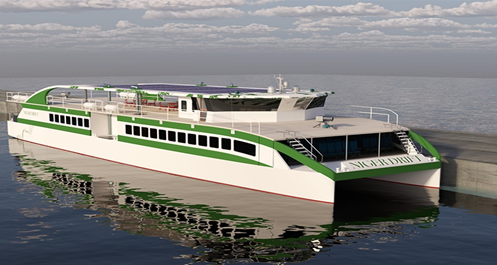
University of Engineering and Technology (BUET) in Dhaka. The M/V NIGER
DRIFT is also powered by CNG and has auxiliary solar and a
hydrokinetic turbine. The aluminum vessel is to be built in blocks in the Naval
Shipyard Ltd Port Harcourt and transported for approximately seven hours by
truck to Onitsha. The Onitsha to Lokoja ferry travels at a 20 kn cruise
speed is expected to take 5 1/2 hours. Temperature cooling inside the
passenger space is by natural air circulation system (similar to the new Lagos
ferries). Among the innovations are a hydro kinetic turbine harnessing the flow
of water converting it to energy. Another innovation is a pontoon landing
which minimizes the effect of high/low water during embarkation and
disembarkation process– and is used as a platform for CNG filling / charging.
The seven-member team is led by Md. Kawsar Mhamud Zidan.
The students will
present their designs at the WFSA’s Ferry Safety and Technology meeting to be
held May 5-7, 2026, in New York City.
Lagniappe: The Charles R. Cushing recognition prize
for esthetics. Charles Cushing the prominent U.S. naval architect, who has
been involved in designs of vessels from the early containerships to the latest
high-tech vessels, has been key is guiding the specifications International
Maritime Students Design Competition and guiding his fellow judges in their
considerations. This year he was unable to undertake the naval
architecture judging so we asked him to follow his passion and select the most
beautiful vessels. Spoiler alert—the illusion of swiftness was what he finds
compelling. Awardees: First place Pakistan Navy Engineering College,
Karachi; second place, University of Southampton, UK; and third place
University of Ibadan, Nigeria.