

Office Address
123/A, Miranda City Likaoli Prikano, Dope
Phone Number
+0989 7876 9865 9
+(090) 8765 86543 85
Email Address
info@example.com
example.mail@hum.com


123/A, Miranda City Likaoli Prikano, Dope
+0989 7876 9865 9
+(090) 8765 86543 85
info@example.com
example.mail@hum.com
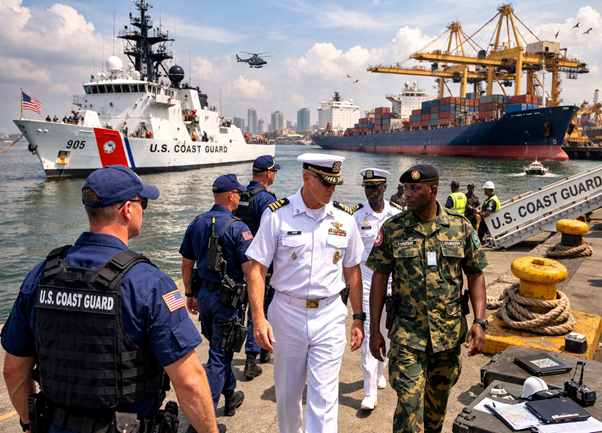
Official sources confirmed that the delegation is
scheduled to visit the Lagos Port Complex Apapa and the Tin-Can Island Port as
part of the exercise, which is expected to conclude on Friday, 6 March
2026. The visit comes at a
particularly sensitive time for Nigeria’s maritime sector. For more than a
decade, vessels departing Nigerian ports for the United States have been
subject to a “Condition of Entry” imposed by the US authorities. The measure was first introduced in 2014 after
concerns were raised about deficiencies in Nigeria’s implementation of the ISPS
Code, particularly around access control, perimeter security and oversight
of port operations. The Condition of
Entry requires ships arriving in US waters from Nigerian ports to undertake
additional security measures before docking. These include enhanced onboard
security protocols, detailed record-keeping and, in some cases, advance
verification procedures. While the restriction stops short of an outright ban,
it has been widely regarded as a reputational setback for Africa’s largest
economy and a factor contributing to higher operational costs for
Nigerian-bound and Nigeria-origin cargo.
Industry stakeholders have long argued that the designation has also
influenced insurers’ risk assessments, contributing to elevated war risk
premiums on shipping linked to Nigerian ports. The Federal Government has since
undertaken a series of reforms aimed at tightening maritime security,
strengthening inter-agency coordination and upgrading surveillance
infrastructure across key port facilities.
According to official sources, the primary objective
of the current US Coast Guard assessment is to evaluate Nigeria’s compliance
with ISPS Code requirements, with a view to determining whether conditions now
warrant the removal of the Condition of Entry. The outcome of the inspection is
therefore being closely watched by port operators, shipping lines and insurers
alike.
Regulatory authorities indicate that detailed logistical arrangements
have been put in place to ensure a smooth and secure inspection process. Officers responsible for overseeing entry
and exit points at both ports have been directed to intensify access control
measures throughout the duration of the visit.
Security presence within the port has also been heightened. K9 units and
their handlers have been instructed to maintain a visible deployment, while
operations teams are conducting regular patrols to guarantee free traffic flow
and eliminate encumbrances such as loitering, hawking and unauthorised parking.
The measures are designed not only to facilitate the inspection but also to
demonstrate the robustness of existing security protocols.
Official sources described the Coast Guard’s presence
as a standard but rigorous compliance audit, noting that such assessments are
conducted periodically in ports around the world. They added that Nigeria’s
maritime authorities remain confident that improvements made in recent years
will be reflected positively in the team’s findings.
Should the United States ultimately lift the Condition
of Entry, it would mark a significant milestone for Nigeria’s shipping
industry. Beyond restoring confidence in the country’s port security
architecture, it could help reduce additional compliance costs borne by
operators and potentially ease insurance burdens linked to perceived security
risks.