
Office Address
123/A, Miranda City Likaoli Prikano, Dope
Phone Number
+0989 7876 9865 9
+(090) 8765 86543 85
Email Address
info@example.com
example.mail@hum.com


123/A, Miranda City Likaoli Prikano, Dope
+0989 7876 9865 9
+(090) 8765 86543 85
info@example.com
example.mail@hum.com
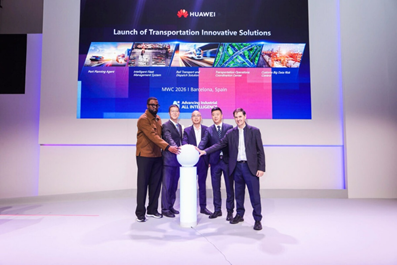
During MWC Barcelona 2026, Huawei and Tianjin Port Group announced the
collaborative development of the Intelligent Horizontal Transportation 2.0
Solution.
Centring on mixed
traffic, the solution addresses the challenges of horizontal transportation
automation at traditional terminals. It provides a cost-effective, highly
adaptable, and innovative path for the smart transformation of global ports,
marking a shift in port automation from operating in closed scenarios to more
open collaboration.
The solution has
evolved from conventional independent vehicle intelligence to a
vehicle-road-cloud synergistic architecture, establishing a triple-intelligence
system comprising a smart cloud, intelligent roads, and autonomous vehicles. It
creates an efficient closed loop through collaboration among cloud-based global
scheduling, roadside sensing, and onboard real-time decision-making.
The solution adopts a microservice architecture
design based on cloud-native principles. The cloud-based brain performs global
path planning, smart decision-making, resource configuration, and exception
handling. The onboard system
is capable of high-precision environment sensing, obstacle avoidance, and
precise control, while the roadside sensing system detects surrounding
conditions and synchronises traffic information. This architectural design
helps ensure overall operational efficiency while maintaining the safety and
reliability of large-scale fleets operating in complex environments.
Huawei and Tianjin Port Group jointly develop Intelligent Horizontal
Transportation 2.0 Solution
Core Competitiveness: All-Domain Mixed Traffic with Global Optimal
Scheduling
This solution helps
customers achieve progress across several fronts, most notably in all-domain
mixed traffic. It enables AI robots of transportation (ARTs) and manual
container trucks to operate safely and seamlessly together. Leveraging multiple
roadside sensors and cloud-based smart scheduling algorithms, the system
identifies the driving routes of manual container trucks in real time and
dynamically plans operational paths. This moves beyond the limitations of
physical isolation traditionally used in automated terminals.
The solution also supports the coordinated
management of large-scale fleets by allowing 300 vehicles, including ARTs and
manual container trucks, to operate together efficiently. The cloud-based smart
scheduling mechanism ensures system stability and efficient operations when
large numbers of vehicles are working simultaneously. The solution also
significantly reduces manual intervention, with the ART intervention rate
dropping below 0.1 per cent. This helps resolve deadlocks commonly encountered
at intersections.
Industry Benefits: Solving Mixed Traffic Challenges and Supporting
Traditional Terminal Transformation
The solution delivers
tangible benefits to customers. It allows traditional terminals to adopt
digital and intelligent capabilities at lower cost, without the need for
re-planning or large-scale infrastructure reconstruction. This provides a
cost-effective, highly adaptable, and easy-to-implement transformation path for
the many terminals worldwide that still rely on traditional manual container
truck operations.
Chen Haiyong,
President of Huawei Smart Port Business Unit, pointed out that 5G is no longer
an option but a foundation for ports worldwide to become automated and
intelligent. Traditional Wi-Fi and 4G cannot meet the demands of modern ports.
For key smart port scenarios such as smart horizontal transport in mixed
traffic, millisecond-level remote control, and emergency communications, 5G’s
reliability, low latency, and high bandwidth are basic requirements. It serves
as the digital backbone for stable and continuous automated operations and
helps create a fully connected environment where data flows smoothly, and
systems work together more effectively.
Looking ahead, Huawei and Tianjin Port Group will
continue to deepen their cooperation, driving the application of 5G-A, AI, and
other advanced technologies in ports to support the digital and intelligent
transformation of the global port industry.
To date, Huawei has served more than 100 ports
worldwide. Moving forward, the company remains committed to its vision of
“driving mobility and logistics into the intelligent world”. Guided by its
“platform + ecosystem” strategy, Huawei will match technology to specific
operational scenarios, applying technologies such as 5G and AI to advance the
digital and intelligent transformation of global ports.