




Office Address
123/A, Miranda City Likaoli Prikano, Dope
Phone Number
+0989 7876 9865 9
+(090) 8765 86543 85
Email Address
info@example.com
example.mail@hum.com


123/A, Miranda City Likaoli Prikano, Dope
+0989 7876 9865 9
+(090) 8765 86543 85
info@example.com
example.mail@hum.com
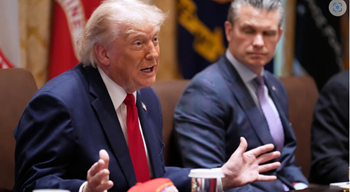
Speaking during a
cabinet meeting, about the
Strait of Hormuz, Trump said tie will be “open to everybody”,
adding that this remains part of the ceasefire negotiations.
“It’s
international waters. Nobody’s going to control it. We’re going to watch over
it. We’ll watch over it, but nobody’s going to control it,” Trump said.
“That’s part of the negotiation that we have.”
He also warned Oman
not to interfere in the Strait of Hormuz negotiations, while rejecting the idea
of a short-term deal that would allow Iran and Oman to control the critical
waterway on which the world oil and gas supply largely depends.
“Oman will
behave just like everybody else, or we’ll have to blow ’em up,” he said.
The US president reiterated that he believes Iranian
leaders “want very
much to make a deal”. Acknowledging
that the diplomatic breakthrough has not yet materialised, Trump noted that
while current progress remains incomplete, he expects a successful resolution. “So far, they haven’t gotten there.
We’re not satisfied with it, but we will be. We will be,” Trump
said. However, the American leader
paired his diplomatic optimism with a stark, uncompromising warning of further
unilateral action should talks collapse entirely, stating, “Either that or we’ll have to finish
the job.” Meanwhile, the
White House has flatly denied a broadcast by Iranian state television asserting
that Tehran and Washington had successfully negotiated a preliminary blueprint
to halt the ongoing hostilities in West Asia, branding the claims a “complete
fabrication”.
The state-backed
Iranian broadcast had detailed an alleged outline of a Memorandum of
Understanding (MoU), asserting that the framework mandated the United States
dismantle its naval blockade against Iran and pull back its military
deployments from Gulf waters to facilitate a comprehensive regional truce. The
White House said in a post on X,
“This report from Iranian-controlled media is not true and the MOU they ‘released’
is a complete fabrication. Nobody should believe what the Iranian state media
is putting out. FACTS MATTER.” According
to the unverified claims aired by Iranian state networks, international
merchant transit across the vital Strait of Hormuz was projected to normalise
to pre-conflict frequencies within thirty days. This tentative arrangement was reportedly
contingent on specific conditions, including the complete removal of the US
military footprint from territories surrounding Iran. The contested Strait of Hormuz continues to
serve as one of the global economy’s most indispensable maritime choke points,
channelling a massive volume of international crude supplies from the Persian
Gulf out to global consumer markets.