




Office Address
123/A, Miranda City Likaoli Prikano, Dope
Phone Number
+0989 7876 9865 9
+(090) 8765 86543 85
Email Address
info@example.com
example.mail@hum.com


123/A, Miranda City Likaoli Prikano, Dope
+0989 7876 9865 9
+(090) 8765 86543 85
info@example.com
example.mail@hum.com
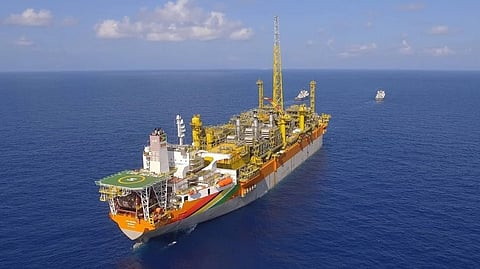
Guyana was already the world’s fastest growing economy before the
US-Israeli war on Iran drove up oil prices. Now, the tiny Caribbean nation of
nearly one million people will reap an even bigger bonanza as the conflict
reshapes global energy markets. The
war that caused one of the largest energy disruptions in history highlights the
growing importance of countries including Guyana that offer political stability
and geographically unrestricted access to their estimated 11 billion barrels of
oil reserves. This growing windfall from crude brings pressure
from business owners and locals on the government to use its billions of
dollars to boost other parts of the economy. “The world has seen too many
energy booms that left behind ghost towns, depleted forests and bitter populations.
Guyana will not be that story,” President Irfaan Ali said in an address at Rice
University’s Baker Institute this month.
Rapid development by an Exxon Mobil-led oil
consortium, which controls all of Guyana's oil production, grew output to over
900,000 barrels per day in just seven years, a pace without recent precedent as
offshore projects can typically take twice as long just to produce the first
drop of oil. Guyana's GDP more than
quadrupled to $27.5 billion between the time the taps started flowing in 2019
to 2024, according to World Bank data. Guyana was previously one of the poorest
countries in South America and oil-fueled growth can be seen across the capital
of Georgetown, where construction is taking place on new modern office
buildings, upscale hotels and rows of single-family homes that resemble those
that could be found in US suburbs. Exxon billboards and ads for other petroleum
companies play on the radio, serving as reminders for the industry that helped
enable the growth.
The government's long-term challenge is to fortify the country against
an implicit pitfall - the economic cycle of boom and bust oil prices. Guyana
needs to look no further than its neighbor Venezuela for an example of how
political dysfunction and overreliance on oil money can cripple an economy
despite having one of the largest estimated oil reserves in the world. One of
Guyana's strategies is its 2019 sovereign wealth fund holding all oil revenue
which allows the government to draw funds for development projects at a steady
rate. Crude prices, up 30 per cent
since the start of the Iran war in late February, could further swell Guyana's
oil revenue. Assuming an oil price of $100 per barrel through the rest of the
year at current production volumes, Guyana's share of oil revenue could be
worth roughly $4.3 billion, 67 per cent higher than last year, according
to Reuters calculations.
More importantly, Guyana is poised to start
receiving a significantly larger share of oil production earlier than expected.
The Exxon consortium currently takes 75 per cent of the oil to recoup its
initial exploration and development costs. And now, the consortium could
recover the costs this year, Exxon has said. When that happens, the country's
share of the profit oil will climb from 12.5 to 50 per cent.
Ali cautioned that expectations needed to be
managed, as any windfall due to higher oil prices would be offset by higher
import costs for nearly all goods including fuel and fertiliser.
“This is the complexity of the messaging when
people wake up every morning and see the headlines that you're flush with
money, it drives a certain expectation,” he said in his Baker Institute
address.
Some local infrastructure has not improved at the
same pace that the oil industry has developed. Open sewage drains line the
streets of Georgetown and electricity outages remain a common occurrence.
Guyana sits at the center of a region that includes the established oil
and gas economies of Venezuela and Trinidad and Tobago, as well as Suriname,
where the sector is emerging. The area benefits from direct, unrestricted
access to the Atlantic, without maritime chokepoints vulnerable to blockades
like the Strait of Hormuz. Guyana’s
low break-even prices in the $25 to $35 per barrel range, and proximity to US
markets that are supportive of fossil fuel development, further compound
long-term advantages, said Tarron Khemraj, a professor of economics and
international studies at the New College of Florida, who has studied Caribbean
countries including Guyana. Spot
prices for Guyana’s four crude grades - valued for their light to medium sweet
quality - have surged over the past three months, with the Liza benchmark
reaching a high of $120 per barrel from $68.98 on February 27 before the
conflict in the Middle East began.
Even if traffic through the Strait of Hormuz resumes soon and oil prices
return to pre-war levels, experts say Guyana’s track record as a geopolitically
stable source of oil will further solidify. “The war may end next month, but it will be a changed world,” Khemraj
said.
Still, numbers that look like a boom may belie the
full reality of the broader economy.
While Guyana has recorded double-digit percentage
GDP growth each year since oil production began, most of that expansion has
been concentrated in the petroleum sector, rather than broad-based activity.
Oil and gas and support services accounted for more than 75 per cent of the
country’s GDP last year, according to government data.
As part of its effort to make sure more of the oil revenue trickles
down, the government is also moving to expand its local content law, originally
passed in 2021, that requires oil and gas firms to contract with Guyanese-owned
suppliers and vendors in a number of specific areas, such as janitorial, food
or transportation. The regulation
requires petroleum companies to procure a certain percentage of services from
Guyanese businesses, for example, 25 per cent of medical services and 90 per
cent of catering services. The government is considering amendments to add more
service areas and increase the percentage requirements for some existing ones,
Michael Munroe, director of the local content secretariat, said in an
interview.
Business owners say that expanding the requirements
will help support more jobs and the development of skilled labor.
“We're able to provide all of the same medical
services as an international company,” said Ayesha Wilburg, founder and CEO of
a Georgetown-based health clinic.
Rising oil activity has also led to a similar
explosion in demand for private transportation services in Georgetown, where
residents often travel by cab.
Nazim Baksh, general
manager of Sean’s Transportation Services, said the company expanded from seven
employees to about 20 and also upgraded its fleet from sedans to add more SUVs.
Challenges remain, however, including complaints from Guyanese business
owners about so-called fronting. Panelists at the Guyana Energy Conference in
February acknowledged the problem, where foreign companies use local entities
but retain actual control of the business. Vanita Ally, Medical Director and
founder of Phoenix Clinicare, a Guyanese-owned medical center, said that
receiving a certificate to provide services to oil firms has not resulted in
much additional revenue and inflation is also increasing her operating costs.
“International companies are benefiting a lot more than local people
(from the oil industry),” Ally said.
Drivers are now paying more at the pump, like other countries, adding to
cost of living concerns. Guyana lacks a refinery and must import gasoline,
diesel and other refined products. “For
Guyana, as a country that is now a net producer and exporter of energy, (higher
oil prices) can mean positive things, but of course, that isn't necessarily
what people see and feel every day because it means that energy prices are
going up,” said Alistair Routledge, President of Exxon’s Guyana operations at a
press conference in March.
“We recognise this is
a mixed blessing for people in Guyana.”