


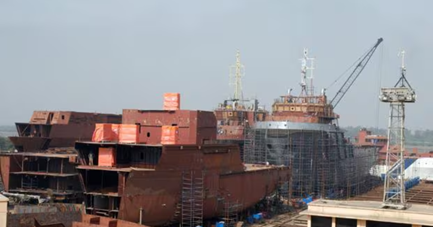
Shipbuilding can drive Bengal’s industrial revival
Recent
discussions between the Bengal government and the Union ministry of ports,
shipping and waterways have centred on upgrading maritime infrastructure and
exploring new deep-sea port options. Plans for a major port-led industrial
cluster, coupled with modern shipyards, could position Bengal as a key
shipbuilding and logistics hub on India’s eastern seaboard.
A proposed deep-sea port at
Dadanpatrabar has been highlighted as a technically stronger and logistically
advantageous site compared with earlier locations. The area offers a large
tract of encumbrance-free, state-owned land, making it suitable for integrated
maritime infrastructure without major land acquisition hurdles. Developing a greenfield shipyard near this
deep-sea port could significantly amplify economic returns by combining port
operations with ship construction, repair and allied manufacturing. With participation from
established Indian shipyards and possible collaboration with international
builders, such a facility could help re-establish Bengal as one of India’s
principal shipbuilding centres.
Shipbuilding is widely
recognised as an industry with high multiplier effects on employment and
industrial output. Each direct job in a shipyard typically supports several
additional jobs in sectors such as steel fabrication, engineering services,
logistics, electronics, marine equipment manufacturing and other ancillary
industries. Global experience from
leading shipbuilding nations such as Japan, South Korea and China shows that
sustained investment in shipyards can accelerate broader industrialisation and
long-term regional growth. For Bengal, a large-scale shipbuilding programme
could strengthen the manufacturing base while creating diverse opportunities
for SMEs and specialised suppliers in the maritime value chain. The Dadanpatrabar region offers direct access to
the Bay of Bengal and major Southeast Asian shipping routes, boosting its
attractiveness for export-oriented shipbuilding and maritime trade. The
proposed site can be connected to key road and rail corridors, including
National Highway 116B and the Tamluk–Digha railway line, enabling efficient
multimodal logistics for raw materials and finished vessels. Bengal
benefits from a large pool of industrial workers at competitive labour costs,
proximity to steel production facilities, and an established cluster of
shipyards and maritime institutions around the Hooghly and in Kolkata. With the
Syama Prasad Mookerjee Port providing strong connectivity, the region already
offers a mature ecosystem that can support large shipbuilding projects.
Competition for maritime and
shipbuilding investments is intense, with states such as Gujarat, Tamil Nadu,
Andhra Pradesh, Maharashtra and Odisha offering proactive policies and
attractive incentive packages. For Bengal to regain prominence, it will need a
coordinated strategy that secures and optimally utilises strategic land parcels
while offering competitive fiscal and non-fiscal incentives. Engaging with
domestic and international shipbuilders through sustained outreach and investment
promotion will be crucial. Expert advisory support from professional
organisations and leading institutions such as IIT Kharagpur and Indian
Maritime University can help shape viable project models and technology choices. The
Union government can play an enabling role by streamlining regulatory approvals
and supporting key projects through national maritime and logistics programmes.
Strategic coordination between central and state agencies can help fast-track
critical infrastructure and attract global shipbuilding majors to the eastern
coast. Collaboration between
neighbouring maritime states, particularly Bengal and Odisha, could support the
development of an Eastern India Shipbuilding Cluster extending from Kolkata to
Paradip. Such a corridor would create economies of scale in shipbuilding,
repair, offshore services and marine equipment manufacturing. The success of large-scale shipbuilding and
port-led industrialisation depends on the availability of skilled manpower.
While Bengal already hosts several nationally important maritime and
engineering institutions, there is scope to create a dedicated Centre of
Excellence in maritime studies, shipbuilding, ports, inland waterways and river
tourism.
Such
a centre could develop specialised curricula, research programmes and industry
partnerships tailored to future maritime needs, including offshore energy and
renewable technologies. It would also strengthen the state’s ability to attract
Global Capability Centres focused on design, engineering, and innovation in the
maritime domain.
With the right mix of
infrastructure, policy support, skilled workforce and collaborative governance,
Bengal can leverage shipbuilding to anchor a wider industrial revival. A modern
shipyard and deep-sea port cluster along its coast would enhance India’s
maritime capabilities and support regional trade and security across the Bay of
Bengal and broader Indo-Pacific. By
reclaiming its maritime legacy and aligning with contemporary shipping and
logistics demands, Bengal has the potential to emerge as a premier shipbuilding
and maritime innovation hub in Eastern India.
Related News