



Office Address
123/A, Miranda City Likaoli Prikano, Dope
Phone Number
+0989 7876 9865 9
+(090) 8765 86543 85
Email Address
info@example.com
example.mail@hum.com


123/A, Miranda City Likaoli Prikano, Dope
+0989 7876 9865 9
+(090) 8765 86543 85
info@example.com
example.mail@hum.com
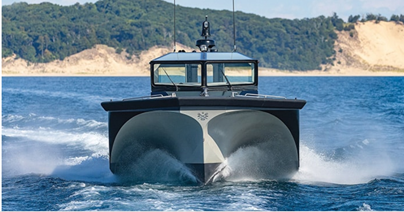
At the 2026 Pennsylvania Defense and Innovation
Summit, hosted by U.S. Sen. Dave McCormick at the U.S. Army War College,
Holland, Mich.-based Ghostworks unveiled MRLN (Multirole Remote Logistics
Node), a remote-pilot autonomy system designed to enable a single vessel to
perform multiple mission types under human-in-the-loop command and control.
MRLN is not a vessel itself, but a mission systems layer that can be integrated
across Ghostworks’ proprietary M-Hull and powercat hull forms, allowing each
vessel to serve as a multirole platform.
MRLN was developed with three partners, each contributing a core piece
of the system: Ghostworks designed, engineered, and built a 40-foot carbon
fiber Minerva-class M-Hull, with speed, range, and payload currently
unrivaled in the industry;general Atomics Aeronautical Systems Inc. (GA-ASI)
brought decades of autonomy and sensor experience from remotely piloted
aircraft and adapted it to the maritime domain and Mercury Marine contributed
its drive-by-wire propulsion technology and Command Gateway product, giving
MRLN the endurance to transit contested and congested environments and to
maintain station for extended periods in demanding conditions. “For
decades, naval planners have had to accept that speed, range, and payload pull
against each other,” said Brooke Kerschbaumer, CEO, Ghostworks. “Optimize for
one and you sacrifice the others. Our vessels were architected to break that
constraint. MRLN gives operators human-in-the-loop command and control over that
tradeoff space, mission to mission, without changing platforms.” Ghostworks
said its vessel designs are intended to address the longstanding tradeoff among
speed, range and payload that has shaped naval procurement for decades. Rather
than optimizing for one at the expense of the others, the company said it seeks
to maximize performance across all three.
The company’s Minerva-class vessel can carry a payload
of 17,500 pounds at a cruising speed of 30 knots and is designed to operate in
Sea State 4 conditions. According to Ghostworks, Minerva is
the first to incorporate MRLN, allowing operators to remotely control the craft
across a range of missions, including fuel delivery, cargo transport and
search-and-rescue operations. The company said MRLN can be deployed across its
proprietary hull forms, providing operators with greater flexibility in
balancing speed, range and payload. Ghostworks said MRLN combines a modular,
subsystem-agnostic architecture with support for a range of payload capacities.
The human-in-the-loop system allows a remote operator to maintain situational
awareness while the vessel operates autonomously and to assume control at any
time. According to the company,
operators can reconfigure mission profiles in the field, enabling the same
platform to be adapted for different operational requirements. Ghostworks said
MRLN is designed to operate independently with its own communications
connectivity across a variety of environments. “Leveraging our development of world-leading autonomy for air-vehicles
into the maritime domain is a natural progression,” said Jeff Hettick, vice
president of GA-ASI’s Agile Mission Systems. “This partnership really
highlights how bringing together the best in the defense industry can yield
exciting new capabilities for our warfighters in a timescale that is
relevant.” “Our role was to prove
that MRLN could meet the control and reliability demands of sustained surface
operations,” said Carl Greiner, Director of Government & Advanced Maritime
Systems, Mercury Marine. “This integration expands what’s achievable in a
remote-piloted maritime system.”