



Golf phone call contributed to fatal Houston bulker collision
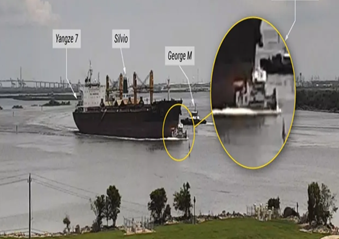
The incident in the
Houston Ship Channel caused Miss Peggy to capsize. Four of the
towing vessel’s five crew were rescued by a nearby vessel, inlcuidng one with
major injuries that required a week in intensive care, and one with minor
injuries. The fifth crewmember, a deckhand who was in the galley at the time of
the collision, was later found dead in the ship’s wreckage. NTSB said the pilot’s long phone call
resulted in him not detecting Miss Peggy and that the Yangze
7’s bridge team failed to maintain a proper lookout, so they also did not
notice the towboat until it was less than a ship’s length ahead of their
vessel. “Audio from the VDR of the Yangze 7 indicated that the
pilot’s discussion included golfing in the Houston area, installation and
financing of a home generator, and travel plans to France, as well as pilot
scheduling assignments, operations, and office logistics unrelated to current operations,”
the NTSB report said.
The pilot repeatedly paused his phone
conversation, carried out using a Bluetooth earpiece, to issue orders in the
minutes before the collision.
The captain
of Miss Peggy failed to maintain a proper lookout and did not
detect Yangze 7 approaching from astern, according to NTSB.
The captain of the towing vessel reported that the first time he saw the bulk
carrier was after the collision, once he had swum from the sinking vessel. The investigators said it was likely that
the use by pilots of personal electronic devices like mobile phones had become
normalised over time as there was no policy against their use. That theory is
supported by the fact that the long phone call unrelated to operations by
the Yangze 7 pilot was to another pilot who was also directing
another vessel in the channel at the time, Panama-flagged tanker Petrel. The end of the phone call was two minutes
before the collision.
NTSB also noted that the bridge team
of Yangze 7 could hear the pilot’s phone call and that it was
not related to ship operations, but concerns were not raised to the pilot.
Their failure to raise concerns showed ineffective bridge resource management,
NSTB claimed. The factors all ultimately contributed to a loss of situational awareness
for the pilot and crews of the vessels involved. The NTSB has recommended that the US Coast
Guard prohibit the non-operational use of electronic devices by pilots and
those directing movements of vessels within USCG jurisdiction. It also recommended
that the American Pilots’ Association develop and implement guidance
prohibiting non-operational use of personal electronic devices by pilots
directing vessel movements.
Related News