India looks to turn sweet corn volumes into export value
According to SuhasDeore, Director at Fresh Mont
International Pvt. Ltd., future growth will depend less on increasing volumes
and more on selecting the right varieties and delivering the sweetness,
uniformity, processing quality and consistency that individual markets
require. India already has an
established international market for processed sweet corn, Suhas says.
"Trade data shows India exported approximately 35.7 million kg of frozen
sweet corn in 2024, valued at around $28 million. Russia was the largest destination,
followed by the United States, Saudi Arabia and the UAE." For Suhas, these figures point to an opportunity
that goes beyond simply expanding production. "The future is not simply
about producing more corn. It is about producing the right corn for the right
application."
It starts with variety selection. "IQF sweet
corn requires good kernel texture, sweetness retention and processing
performance, making the choice of variety an important commercial
consideration. Supersweet varieties are particularly attractive because their
sugar levels can be substantially higher than those of standard sweet corn.
Standard sweet corn generally has around 10–15% sugar, while supersweet types
can reach approximately 25–35% under suitable growing conditions." The
same applies to corn-on-the-cob. Varieties such as CP 2, Sweet 16 and Mithasare
being used in Indian export programmes, with exporters targeting markets
including Russia, the Middle East and Eastern Europe.
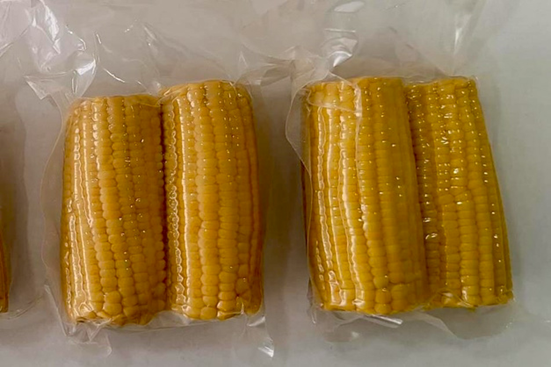
"IQF kernels, single-cob packs, twin-cob packs
and ready-to-eat formats each require different varieties and specifications.
Buyers increasingly look for sweetness, cob uniformity, kernel quality, food
safety, traceability and reliable delivery," Suhas shares, adding that the
opportunity lies in matching production to the requirements of the destination
market. That changes where an export
programme begins. Rather than producing first and finding a market afterwards,
exporters need to consider the end application at the farm level, from variety
selection and crop planning through to harvesting, grading, processing, packing
and cold-chain management. For India,
the potential is significant, given its multiple production regions, large
agricultural base and established agricultural expertise. "Access to major
international markets is another advantage, with proximity to the Middle East
and Asia particularly relevant as demand for convenient and processed vegetable
products grows in these regions."
At the same time,
consistency remains one of the industry's biggest challenges.
"International buyers do not simply want Indian origin. They want the same
sweetness, size, appearance and eating quality shipment after shipment,"
Suhas says. "That puts greater emphasis on controlled production and
supply-chain management. For exporters supplying processed products, the
ability to maintain raw material specifications is just as important as the
processing technology itself."
The development of
value-added formats could allow Indian suppliers to capture more value from the
crop. Instead of relying solely on fresh corn-on-the-cob sales, exporters can
serve different market segments through IQF kernels, single- and twin-cob packs
and ready-to-eat products.
"This market-specific approach is central to
our export strategy as we continue to supply to the Middle East, Southeast
Asia, Europe and Russia, aligning sourcing, variety, quality and packing with
the requirements of individual destinations. With an established export market
already in place, India's sweet corn industry is increasingly expected to move
away from competing on volume alone, turning a widely grown crop into a more
differentiated export product," Suhas concludes.
Fresh Mont will be
exhibiting at Asia Fruit Logistica in Hall 3, Booth 3H55

Related News