
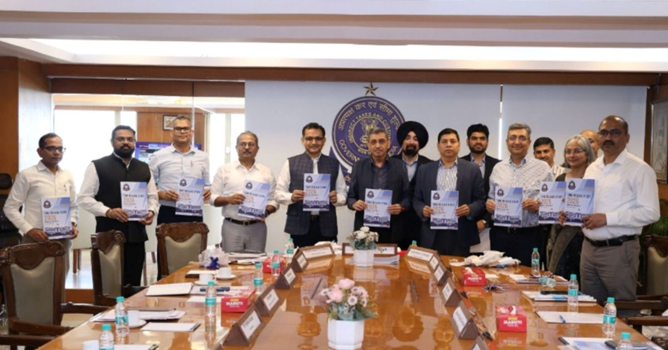
CBIC releases Time Release Study 2026 of Jawaharlal Nehru Custom House/
Speaking on the occasion, the
Member CBIC commended the officers of JNCH and all participating stakeholders
for the sustained improvement in cargo clearance timelines, and reiterated
CBIC’s commitment to using data-driven studies such as TRS to further trade
facilitation and Ease of Doing Business. He noted that as India advances
towards Viksit Bharat @2047, an efficient, technology-driven and globally
competitive cross-border trade ecosystem shall be critical to the nation’s
deeper integration with global value chains.
TRS is a performance measurement tool recommended by the World Customs
Organization (WCO) to assess the time taken for release and clearance of cargo,
enabling identification of bottlenecks and targeted trade facilitation
measures. JNCH has been conducting TRS annually. The TRS 2026 report shows that the Average
Release Time (ART) for import cargo has improved to 65 hours 53 minutes, down
from 72 hours 52 minutes in TRS 2025, a reduction of about 9.6%, despite a 16%
rise in the number of Bills of Entry handled. AEO consignments recorded an ART
of 40 hours 40 minutes, well within the 48-hour NTFAP benchmark, as against 76
hours 59 minutes for non-AEO consignments.
On the export side, the
overall release time for Shipping Bills declined to 195 hours 49 minutes, from
208 hours 15 minutes observed during the previous TRS. Further, customs
clearance of exports took only 2 hours 12 minutes on average, while the
remaining time pertained to logistics-related operations.
Related News