
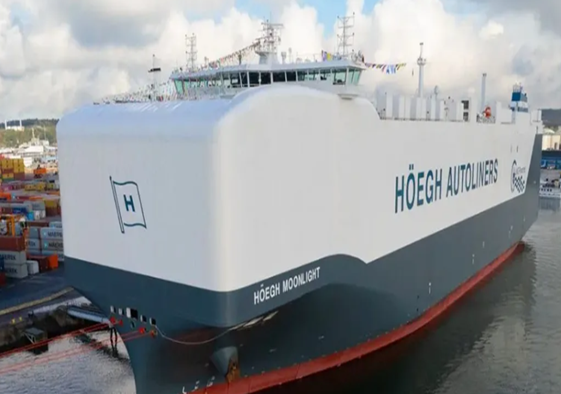
Höegh Autoliners adds six car carriers at China Merchants
The latest
newbuildings are scheduled for delivery between 2029 and 2031 and extend the
company’s Aurora newbuilding project to a total of 18 vessels, all to be
constructed by China Merchants Heavy Industry (Jiangsu) (CMHI). Benefiting from
long-term strategic partnership advantages, large-scale serial construction
economics and mature vessel design iteration, Höegh Autoliners said it had secured
highly competitive contract terms for the expanded fleet, although did not
reveal financial details. Additionally
the company has obtained a six-month construction option for four extra vessels
under identical contractual conditions, alongside reserved building slots for
another four units valid until 31 December 2027. Including the 12 vessels previously
delivered or under construction, the overall Aurora-class programme is scalable
to a maximum of 26 vessels. Designed with low-carbon and future-proof
specifications, each Aurora-class vessel holds DNV’s ammonia and methanol-ready classification notations. Equipped
with Everllence main propulsion systems and Kongsberg Maritime intelligent
bridge solutions, the vessels feature a cargo capacity of up to 9,100
cars. Compared with traditional PCTC tonnage, the Aurora series cuts carbon
emissions by up to 58%, delivering superior environmental performance and
operational efficiency. The vessels are fully reserved with technical
conversion potential for future ammonia fuel adaptation, laying a solid
foundation for long-term zero-carbon transformation and further consolidating
Höegh Autoliners’ leading edge in sustainable automotive logistics shipping.
The Aurora-class project stems from a strategic cooperation framework jointly
established by Höegh Autoliners and CMHI in 2021. The first batch of four
vessels was officially confirmed in 2022, and the programme has achieved steady
phased expansion, growing from 4 initial units to 12 and further to the current
18 firm orders.
Höegh Autoliners
currently operates around 40 ro-ro vessels in global trade systems and makes
more than 2 000 port calls each year.
Related News