


WinGD shows payback on retrofit pathways to net-zero
While the engine technology to decarbonise existing vessels is
increasingly available, the remaining challenge is aligning fuel economics and
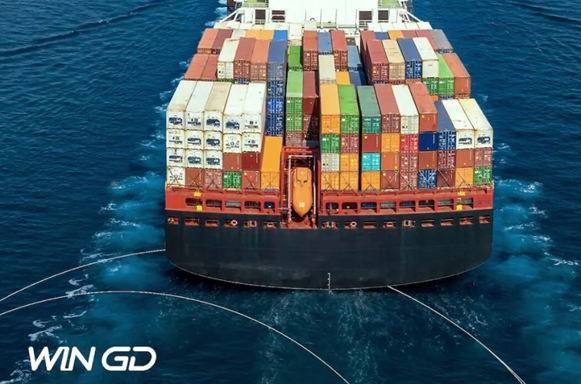
regulation with targeted emissions reductions. The report models a 16,000 TEU
container vessel being converted in 2030 to use alternative fuels via WinGD’s
high-pressure dual-fuel engines for LNG (X-DF-HP), methanol (X-DF-M) and
ammonia (X-DF-A). Core costs – including conversion investment, fuel, and
carbon costs – were then modelled under a global pricing regime similar to the
IMO’s Net Zero Framework as drafted.
Under the assumptions modelled, all three retrofit pathways outperform
continued VLSFO operation over the vessel lifetime on costs and emissions
reduction. LNG delivers the strongest and earliest financial return, while
ammonia and bio-methanol deliver substantially deeper emissions reductions but
require longer payback periods.
WinGD Head of Strategic Marketing Carmelo Cartalemi said: “The important
finding is that retrofit technology is increasingly not the limiting factor.
The commercial outcome is determined far more by fuel price, fuel GHG intensity
and the regulatory signal. Shipowners and operators need visibility not only on
what a retrofit costs, but on what every ton of fuel will cost and how its
emissions will be treated by regulations over the vessel’s remaining
life.” As well as calculating net present value (future
returns valued at today’s currency minus investment cost) the report also shows
potential payback periods for a retrofit – and the level of subsidy that would
allow a payback within five years. As an example the best-performing pathway,
LNG to low-GHG LNG, would pay for itself in six years. The
level of subsidy needed to deliver a five-year payback for the fuels is between
US$126-330 per tonne of CO2 equivalent emissions. The indication is that a
reward mechanism for zero or near-zero emissions fuels under IMO’s Net Zero
Framework would need to be of a similar level again to the US$100-380 remedial
units already considered for excess emissions.
A further finding is that retrofit CAPEX itself is not the dominant
factor in the business case. Across the scenarios modelled, fuel cost and
regulatory treatment have a much greater influence on lifetime economics than
the difference in conversion investment.
Cartalemi concluded: “The valuable insight for operators is that
cost-effective options for retrofitting already exist, although the case is far
from settled. For regulators, the modelling shows that without strong policy,
the most cost-effective options are unlikely to include the fuels that
contribute most to shipping’s decarbonisation trajectory.” The Alternative Fuel Retrofits study is the
latest in a series of Fuel Economics Reports published by WinGD. The first
report showed a potential pathway to cost-effective green ammonia uptake, using
real bunkering prices and lifecycle emissions analysis from fuel supplier
Envision Energy. The series aim to provide ship operators with data, insight
and methodologies to evaluate decarbonisation investments – and is part of
WinGD’s commitment to support shipping’s energy transition whichever fuels
operators choose.
Related News