



Keel laid for first Fleet Solid Support ship
Navantia UK has laid
the keel of RFA Resurgent at its Appledore shipyard in North
Devon, marking the formal start of assembly of the first of three new Fleet
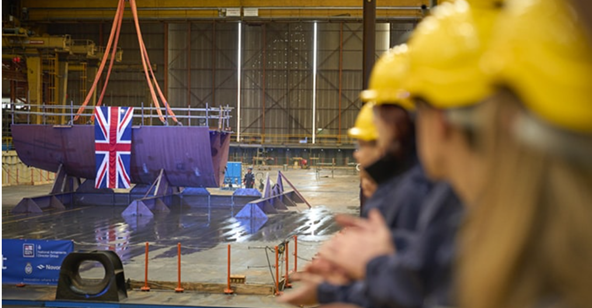
Solid Support (FSS) vessels for the Royal Fleet Auxiliary. The milestone was marked by the lowering of
the first block, a section of RFA Resurgent’s bow, onto the Seahorse barge in
Appledore’s dry dock. The barge, built at Navantia UK’s Methil yard in Fife,
will carry completed blocks from Appledore to Belfast. In keeping with
shipbuilding tradition, a commemorative coin was placed beneath the section for
good fortune. During the ceremony, Commodore Shattock also revealed the names
of the second and third Fleet Solid Support vessels: RFA Reliant and RFA
Resourceful.
The operation was initiated by apprentices from
Navantia UK Appledore and the Royal Fleet Auxiliary, reflecting the central
role that skills and the next generation of shipbuilders and seafarers will
play in delivering the program. The ceremony took place on Merchant Navy Day,
which celebrates the UK’s civilian seafarers, including the men and women of
the Royal Fleet Auxiliary. The keel laying represents the latest major
milestone for Fleet Solid Support, following the start of test block
construction at Appledore in August 2025, completion of the Critical Design
Review in October 2025 and the cutting of first steel at Appledore in December
2025. Since the program began in 2023,
it has remained on schedule and on budget while progressing through a series of
major design and construction milestones.
“The Royal Fleet Auxiliary are the backbone of our Royal Navy and these new
ships will keep our navy ready to operate at range for longer,” said Minister
for Defence Readiness and Industry, Luke Pollard MP. “Seeing the steel cut for
RFA Resurgent last year was a proud moment, and today’s keel laying shows real
momentum behind this vital program. This investment is helping bolster UK
shipbuilding, backing thousands of skilled jobs and apprenticeships in
Appledore, Belfast and beyond.”
“Today is an important moment for Fleet Solid Support, for Appledore and for
the renewal of UK shipbuilding,” said Donato Martínez, CEO of Navantia UK. “The
laying of the keel marks the formal start of assembly of the first ship and is
clear evidence of the momentum we have built across the program.
“FSS is helping to rebuild sovereign industrial
capability in the UK. We are investing in shipyards, creating skilled jobs,
developing apprentices and strengthening the supply chain that will support
future naval programs.
“At Appledore, shipbuilding has returned to a yard
with more than 170 years of history. We are investing in its facilities and its
people, while building the capability needed not only for FSS but for the next
generation of naval vessels, including the autonomous and uncrewed platforms
that will form part of the future Hybrid Navy.
“This milestone demonstrates what sustained
investment and close partnership between government and industry can deliver.
We are proud of the progress being made and focused on maintaining that
momentum as the first FSS ship takes shape.”
The three Fleet Solid Support ships will provide
munitions, stores and provisions to Royal Navy task groups at sea, enabling
ships including the Queen Elizabeth-class aircraft carriers to remain deployed
for longer and operate at greater distance from their home ports.
At around 39,000 tonnes and 216 meters long (708.7 feet), the vessels will be
the largest ships in UK military service after the Queen Elizabeth-class
aircraft carriers.
Construction of ship modules is now taking place at
Navantia UK’s Appledore yard, along with its Harland & Wolff shipyard in
Belfast and Navantia’s yards in Spain. Final assembly, integration and trials
of the ships will take place at their Harland & Wolff shipyard in Belfast.
“Today’s keel laying
marks another important step in the delivery of RFA Resurgent and the wider
Fleet Solid Support program,” said Commodore Sam Shattock, Commodore Royal
Fleet Auxiliary. “Seeing construction progress here in Appledore demonstrates
the momentum behind a project that will provide the Royal Fleet Auxiliary with
world-class capabilities to sustain Royal Navy operations across the globe.
”The commemorative
coin placed beneath the keel continues a proud maritime tradition, linking this
modern programme with generations of shipbuilders and seafarers who have gone
before us. I am delighted that apprentices from both Navantia UK and the Royal
Fleet Auxiliary have been part of this occasion, representing the future of UK
shipbuilding and the future of the RFA.”
The milestone also marks a significant moment in the regeneration of
Appledore, which is undertaking its first shipbuilding activity since the
completion of the Irish Naval Service offshore patrol vessel LÉ George Bernard
Shaw in 2019. Navantia UK is delivering
an investment program of around £15 million at Appledore, including a new roof,
plasma-cutting equipment and a new pipe shop, as part of more than £157 million
being invested across the company’s four UK yards, which together employ around
1,300 people.
The Appledore workforce has grown to 210 people, including 40 apprentices, with
a further 20 apprentices starting this week as part of an intake of 121 new
apprentices across Navantia UK. The yard works closely with nearby North Devon
College to develop the skilled workforce required for future programs. The
programme is also supporting businesses throughout the local and national
supply chain. North Devon-based Wellington Welding, for example, supplies
welding equipment and consumables to the yard as well as providing on-site
testing services.
Another supplier supporting the project is Somerset-headquartered firm Denholm
Industrial Services. Steve Hill,
Managing Director of Denholm Industrial Services, said: “Denholm Industrial
Services is proud to support Navantia UK on the Fleet Solid Support programme.
We are already building on our early work, from providing scaffolding and
painting support for the Seahorse barge in Appledore, to supporting major
reroofing works in Belfast. ”We share
Navantia UK’s drive, ambition, investment and commitment and are focused on
supporting delivery of the FSS programme for the Royal Fleet Auxiliary to the
highest standards. We look forward to continuing our partnership with Navantia
UK on FSS and beyond, helping to deliver lasting benefits for the wider UK
maritime sector.” Appledore has a
long history of naval and commercial shipbuilding dating back to 1855 and
previously constructed bow sections for the Royal Navy’s Queen Elizabeth-class
aircraft carriers. Under Navantia UK, the yard is being developed as a
specialist centre for vessels of up to approximately 125 metres, including
autonomous and uncrewed platforms. Navantia UK has already developed its
LASV75 concept for the Royal Navy’s future Hybrid Navy. The 75-metre,
ocean-going autonomous support vessel is designed around modular mission
systems and rapid, scalable construction. The concept has been developed with
Appledore’s facilities and capabilities in mind.

Related News