



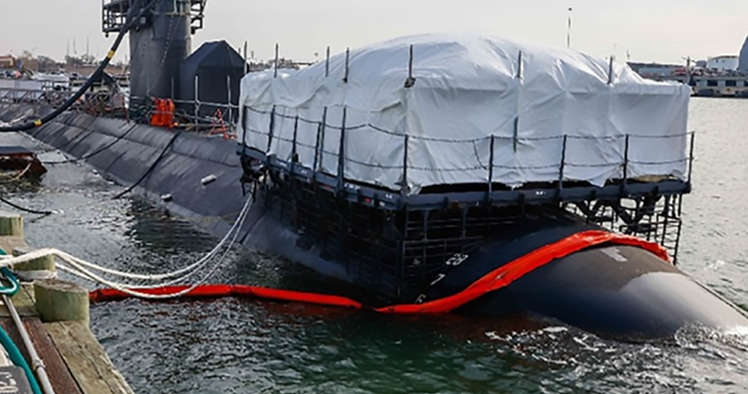
GAO reports on costly Navy attack submarine maintenance delays
The U.S. Government
Accountability Office (GAO) has now released
a public version of a classified report released in June that found that 10
years of maintenance delays to U.S. Navy submarines have resulted in over
15,000 lost operational days and an estimated $3.4 billion in costs. U.S. Navy attack submarine depot
maintenance delays, length of depot maintenance periods, and idle time, FY
2016–2025 Additional delays are on the rise as submarines
wait to be decommissioned—taken out of service—because shipyards don’t have the
capacity to start that process. With more submarines needing to be
decommissioned in the next 5 years, decommissioning delays could cost the Navy
more than $3.1 billion. GAO found that the U.S. Navy has not fully
mitigated attack submarine fleet maintenance and other challenges affecting
readiness. Over the last 10 years, the U.S. Navy has lost more than 15,000
operational days due to maintenance delays and idle time on active attack
submarines. These delays resulted in an estimated $3.4 billion in costs to
sustain crews and submarines that provided no operational capability. Lost operational days include delays
completing depot maintenance and active idle time. Active idle time describes a
period when an attack submarine and its crew must remain pier-side because they
are no longer certified to conduct normal operations and cannot be inducted
into a maintenance period. In addition to lost operational days, the Navy faces
significant challenges with managing inactive idle time for attack submarines.
Inactive idle time describes when an attack submarine designated for
decommissioning cannot be inducted into a dry dock in a shipyard. As a result,
the submarine and its crew must remain pier-side until a shipyard has the
capacity in a dry dock to defuel their nuclear reactor. While the U.S. Navy has made recent
progress in reducing active idle time, inactive idle time for submarines has
grown and is projected to worsen. Without mitigation, 15 attack submarines will
enter inactive idle time from fiscal year 2026 through fiscal year 2030—during
which time the Navy could incur more than 14,000 days of inactive idle time and
$3.1 billion in costs to operate and support these inactive submarines. The
U.S. Navy has not fully evaluated alternative options to more efficiently
decommission attack submarines and develop and implement an inactivation plan
that could allow them to reduce inactive idle time for crews and save
billions. According to the U.S. Navy,
says GAO, its 44 attack submarines, as of fiscal year 2025, provide the United
States an asymmetric advantage to gather intelligence undetected and attack
enemy targets, among other missions. These capabilities make attack submarines
some of the most requested assets by the global combatant commanders. In
compiling its report, GAO analyzed U.S. Navy attack submarine maintenance data
from fiscal years 2016 through 2025, reviewed U.S. Navy documentation, and
interviewed officials. GAO is
making two recommendations including that the U.S. Navy fully evaluate
alternative options to more efficiently decommission attack submarines and
develop an attack submarine inactivation plan that reduces inactive idle time.
The Navy verbally concurred with GAO’s recommendations, but did not provide
written comments. The Secretary of
the Navy should ensure that the Chief of Naval Operations directs the Naval Sea
Systems Command to fully evaluate alternative options for decommissioning
attack submarines more efficiently to optimize shipyard capacity for the
operational fleet. Such options may include, but are not limited to, defueling
outside of dry docks and reducing crewing for attack submarines awaiting
decommissioning. The Secretary of the Navy should ensure that the Chief of
Naval Operations directs the Naval Sea Systems Command to use the evaluation
above to develop and implement a plan for attack submarine inactivations that
reduces inactive idle time for crews and submarines. This plan should include
steps to achieve objectives and timeframes for monitoring and mitigating risk
for inactive idle time reduction.

Related News