

Office Address
123/A, Miranda City Likaoli Prikano, Dope
Phone Number
+0989 7876 9865 9
+(090) 8765 86543 85
Email Address
info@example.com
example.mail@hum.com


123/A, Miranda City Likaoli Prikano, Dope
+0989 7876 9865 9
+(090) 8765 86543 85
info@example.com
example.mail@hum.com
The morning opened with a keynote delivered
by Ben Wassener-Jühe,
Deputy Head of Terminals and Intermodal Strategy, duisport – Duisburger Hafen
AG, which offered a clear reminder that inland terminals are no longer
secondary players. They are coordinators within wider corridors, balancing
rail, road and maritime flows under increasing pressure.
That set the stage for the second keynote, “The Risk No One Owns: How Inaction Shapes the
Future of Intermodal”, where Julian Galvis, VP Sales and Marketing at Tideworks
Technology, argued that
innovation in intermodal is rarely blocked by missing technology. More often,
it is delayed by shared caution. The decision to invest is visible and
accountable. The decision to wait feels safer, but over time, it shapes the
direction of the industry just as much.
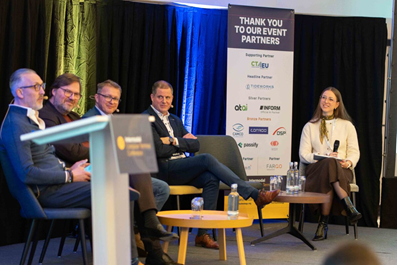
From there, the discussions widened during the opening panel, “The
Developing Role of the Intermodal Terminal in the Combined Transport Ecosystem”,
moderated by Kira Biernat, Marketing Manager, INFORM GmbH, with
contributions from Ben Beirnaert, Board Member at UIRR and General
Manager, Combinant NV, Mark Jansen, Director – Operations,
Hupac, Koen Cuypers, Mobility Expert, Port of Antwerp-Bruges,
and Olivier Hia, General Manager, DP World Liege Container
Terminals. Terminals sit at the centre of a network of operators, infrastructure
managers, technology providers and regulators. Intermodal, by definition,
depends on cooperation. Yet several sessions made it clear that cooperation in
practice is still uneven.
Data sharing quickly
emerged as a recurring theme across the programme.als
In the panel “Synchronising
Terminal Operations with Road and Rail: Building a Seamless,
Technology-Enhanced Connection”, Jonas Lackmann, Venture
Associate, CONROO and Robert Casties, Team Lead Software Development, Eurogate,
focused on practical steps to reduce handover friction between modes.
The reality many in the room recognised immediately
was still there: multiple systems, partial visibility and emails bridging the
remaining gaps. Digital tools have advanced significantly, but harmonisation
across actors remains a work in progress. Real-time information is technically
possible, but not consistently embedded across the chain.
The regulatory update came through the keynote “The CT4EU Campaign – Unlocking the Potential
that Combined Transport (CT) Can Bring to the Competitiveness of the European
Economy”, delivered by Ralf-Charley
Schultze, Director General, UIRR and Chairman of the conference.
Here, uncertainty around
the revision of the Combined Transport Directive was positioned as a continuing
challenge for cross-border planning and investment confidence. Combined
transport may be promoted as a strategic objective at the European level, but
clarity and consistency are still essential to make it work operationally.
Volatility was addressed
head-on in the afternoon panel “Risk and Resilience: Readying your Operation
for Volatility”, moderated by Matti Berndt, Senior Consultant,
bloog, with contributions from Attila Czöndör, Board Member and
CEO, Rail Cargo Terminal – BILK, Remmelt Thijs, Senior Project
Manager, Portwise, and Mark Jansen, Director – Operations, Hupac.
Market fluctuations, infrastructure works and
unreliable arrival patterns mean that theoretical capacity is rarely the whole
story. Yard space, dwell time and buffer planning were discussed as practical
levers rather than abstract metrics. Road freight still accounts for a large
share of freight transport, partly due to its flexibility in volatile markets.
Rail and inland operations require stronger coordination to achieve the same
flexibility. Later sessions on digital maturity and
automation grounded the conversation further. In “From Excel to Ecosystem:
Transforming Inland Terminals into Connected Intermodal Control Hubs”, Ian
Rogerson, Terminal Systems Product Director, Fargo Group, spoke about how
spreadsheets often become the glue between disconnected processes and why
moving beyond that is usually incremental rather than dramatic.
In the closing panel “Realistic, Scalable, Phased: Automation Implementation in Intermodal
Terminals”, moderated by Marcos
Carneiro, Solutions Architect, CONROO and attended by Christopher Cavanagh, Head of Terminal
System Department, Freightliner, Frank
Busse, Partner, HPC Hamburg Port Consulting GmbH, and Frank Kho, Managing Director, ATAI,
one message clearly stood out: before talking about AI, identify the real
operational pain point. Technology should respond to context, not the other way
around. There was also a pragmatic note on change itself. Large-scale
transformation projects can lose momentum. Smaller, visible improvements often
build trust more effectively. Dedicated ownership, clear priorities and
incremental implementation were presented as a realistic way forward.
By the end of the day,
one point came through consistently: intermodal already is an ecosystem. The
challenge now is ensuring the systems, data and policies around it evolve in a
way that allows it to operate more seamlessly.
The conversation
continues on Day 2!