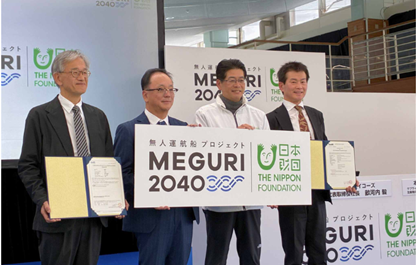
ClassNK awards world’s first MASS notation to domestic container ship “Genbu”
The vessel was
constructed by Kyokuyo
Shipyard Corporation, with ship management handled by IKOUS
Corporation and operations conducted by Suzuyo
Marine Co., Ltd.
In recent years,
the research and development of technology related to autonomous surface ships
(MASS) has been actively carried out with the aims of improving safety by
preventing human error and improving working conditions by reducing the
workload on crew members. Particularly in Japan, autonomous ships are expected
to contribute to securing daily routes to many inhabited remote islands and to
the continuation of domestic shipping business due to the aging of seafarers.
This notation is intended to support initiatives, toward the social
implementation of these technologies reflecting the needs of the industry, from
the standpoint of the classification society. In
order to address the new concept of autonomous and automated navigation
systems, whose evaluation has been difficult under conventional regulatory
frameworks, ClassNK released its “Guidelines for Automated/Autonomous Operation of
ships.” These Guidelines have been developed based on insights
gained through various demonstration projects, and outline the requirements for
each stage of conceptual design, design development, installation, and
maintenance during the operation of automated/autonomous operation
technologies. The autonomous navigation system installed on this vessel has been
developed through the dedicated efforts of the diverse companies participating
in the consortium of the project. ClassNK conducted an examination of the
system, based on its guidelines. Upon confirming it complies with the
prescribed requirements, the “AUTO-Nav2 (All)” was affixed to the vessel. By
obtaining this notation, the vessel is able to respond to the industry’s need
for an official evaluation of highly safe automated navigation technologies and
to externally demonstrate their reliability.
ClassNK will
continue to contribute to the advancement of technologies related to autonomous
ships through the development of appropriate standards and certification
activities, with the aim of reducing the burden on seafarers, promoting work
style reform, and ensuring the stability of maritime logistics.
Related News