




Office Address
123/A, Miranda City Likaoli Prikano, Dope
Phone Number
+0989 7876 9865 9
+(090) 8765 86543 85
Email Address
info@example.com
example.mail@hum.com


123/A, Miranda City Likaoli Prikano, Dope
+0989 7876 9865 9
+(090) 8765 86543 85
info@example.com
example.mail@hum.com
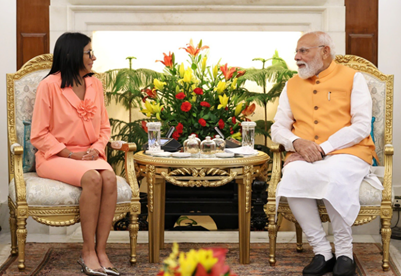
Prime Minister Shri
Narendra Modi welcomed Acting President Rodríguez and held
extensive delegation-level talks, followed by a working lunch, focusing on
expanding cooperation across key sectors including energy, critical minerals,
technology, agriculture, healthcare, pharmaceuticals, transportation, and
people-to-people exchanges. Sharing
details of the discussions, Secretary (East) in the Ministry of External
Affairs, Rudrendra Tandon, highlighted the natural complementarity between the
two countries in the energy sector. “Venezuela
possesses one of the largest oil reserves in the world, while India is one of
the fastest-growing energy consumers with stable long-term demand. This creates
a perfect complementarity for a deeper and more comprehensive energy
partnership,” Tandon stated.
He noted that
Venezuela has already emerged as India’s third-largest supplier of spot crude
oil purchases this month, underlining the growing significance of bilateral
energy ties. Discussions focused on enhancing cooperation across both upstream
and downstream segments of the petroleum industry.
Prime Minister Modi emphasized the importance of the
relationship, describing Venezuela as a valued partner in Latin America and an
important collaborator for advancing the aspirations of the Global South…According to Indian officials, the Venezuelan energy
sector is undergoing a significant transformation, opening new opportunities
for collaboration. India is keen to leverage its expertise across the energy
value chain, while Venezuela views India as a reliable and long-term partner in
meeting future energy demand.
As part of her
visit, Acting President Rodríguez is scheduled to tour Jamnagar, Gujarat, home
to Reliance Industries’ world-leading integrated refining complex. The visit
aims to showcase India’s advanced capabilities in refining, petrochemicals, and
energy infrastructure. She will also visit a leading pharmaceutical company in
Delhi and a Tata Motors manufacturing facility to explore broader industrial
cooperation. Beyond energy, both sides identified significant opportunities for
Indian businesses in Venezuela’s resource-rich economy, particularly in mining,
agriculture machinery, animal husbandry, transportation, automobiles, and
pharmaceuticals. Discussions also covered mechanisms to facilitate greater
participation of Indian companies in the Venezuelan market. India raised concerns regarding pending
payments and dividends owed to Indian pharmaceutical companies and oil joint
ventures operating in Venezuela. Officials indicated that the Venezuelan side
acknowledged these concerns and expressed willingness to address them.
“There is an
acknowledgement from the Venezuelan side that India has stood by Venezuela in
good and bad times. It is a longstanding relationship, and India remains a
preferred partner for Venezuela’s future development,” Tandon noted.
Healthcare
cooperation also featured prominently in the discussions. Prime Minister Modi
highlighted India’s globally recognized generic pharmaceutical industry and
suggested that Venezuelan officials study the successful Jan Aushadhi
initiative, which provides affordable medicines to millions through a
nationwide network of dedicated outlets.
The visit is expected to pave the
way for a renewed phase of economic engagement, reinforcing energy security,
industrial collaboration, and South-South cooperation between the two nations.