

India expedites maritime capacity expansion as Govt pushes Viksit Bharat 2047 goals
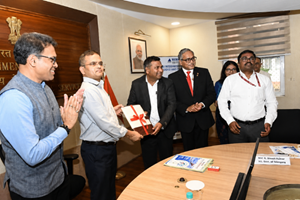
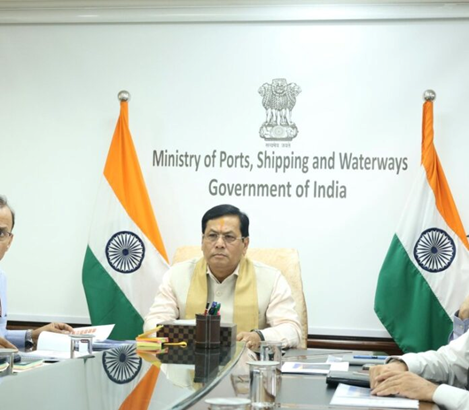
Chairing a
high-level review of the Ministry’s Viksit
Bharat targets, Union Minister
for Ports, Shipping & Waterways Shri Sarbananda Sonowal directed
officials to accelerate implementation of flagship projects while maintaining
strict adherence to timelines. Sonowal urged officials across the Ministry,
major ports and the Inland Waterways
Authority of India (IWAI) to work with a unified approach to achieve
India’s long-term maritime ambitions.
The review comes as the Ministry reports significant progress across
multiple performance indicators. India has consolidated its position as the
world’s largest ship recycling nation, while inland waterways cargo has already
crossed 200 million tonnes, achieving the Maritime India Vision (MIV) 2030 target several years ahead of
schedule. “These achievements
demonstrate what India can accomplish when policy, execution and teamwork move
together. Under the visionary leadership of Prime Minister Shri Narendra Modi, the maritime sector has emerged
as one of the strongest pillars of India’s economic transformation. We must
continue to work with the same sense of purpose, uphold the Prime Minister’s
mantra of ‘Speed and Scale’, and ensure that every milestone under ‘Viksit
Bharat 2047’ is delivered on time,” Sarbananda Sonowal said.
The Minister also called on officials to strengthen
institutional resilience by incorporating lessons from global disruptions into
future planning.”The evolving geopolitical situation has shown that resilience
is as important as growth. Every challenge offers an opportunity to build
stronger systems, enhance capacity and prepare India for the future. Our
planning must anticipate global uncertainties while keeping India’s growth
trajectory firmly on course,” Sonowal said.
The Ministry is
pursuing one of the country’s largest maritime infrastructure expansion
programmes, targeting more than 700 million tonnes per annum (MTPA) of
additional port capacity by 2030. Among the flagship projects are the Vadhavan
Port, which will add 164 MTPA of capacity by 2030-31, the Tuticorin Outer
Harbour project with 39 MTPA, and the Kandla Tuna Tekra Terminal, expected to
contribute 33 MTPA by 2027-28.
Overall, the Ministry plans to create an additional 682 MTPA of capacity
by 2030 through a combination of new infrastructure, mechanisation and private
investment. This includes 306 MTPA at major ports, 193 MTPA at key non-major
ports and another 183 MTPA through mechanisation, operational efficiency
improvements, public-private partnerships and capacity augmentation at emerging
non-major ports.
The Ministry aims to increase cargo handling
mechanisation across ports from 76% in FY 2025-26 to 93% by 2030, significantly
improving operational efficiency and reducing turnaround time. Private sector
participation is also expected to expand substantially. Cargo handled through
public-private partnership (PPP) projects is projected to rise from 44% in
2013-14 to 85% by 2030-31, reflecting the Government’s continued emphasis on
private capital and operational expertise in port development. The Ministry has
also set a target of achieving 100% digitisation across the maritime sector by
2030, with integrated digital platforms expected to improve logistics
efficiency, transparency and service delivery.
India’s
shipbuilding sector also recorded strong momentum during the review period.
Domestic shipbuilding output increased 41%, rising from 40,923 gross tonnes
(GT) in 2024 to 57,637 GT in 2025. To support long-term manufacturing growth,
the Government has granted in-principle approvals for greenfield shipbuilding
clusters in Tamil Nadu, Andhra Pradesh and Gujarat, each with a planned
capacity of 1.2 million GT. Similar approvals for Maharashtra and Odisha are
expected by August-September 2026.
A tripartite Memorandum of Understanding has also been signed with HD
Hyundai-KSOE for developing a shipbuilding cluster in Tamil Nadu, while
extending 100% financial support for common maritime infrastructure required
for these industrial ecosystems. The review noted a sharp improvement in the
value of vessels being built domestically. The average contract value per
vessel has increased more than fivefold to ₹212 crore, compared with ₹41 crore
previously, indicating India’s growing capability to manufacture larger and
technologically advanced ships.
The Union Minister
underlined the Ministry’s roadmap under Viksit Bharat 2047 to position India
among the world’s leading maritime economies by strengthening infrastructure,
expanding logistics capacity, boosting domestic manufacturing and enhancing
global competitiveness.
Related News