



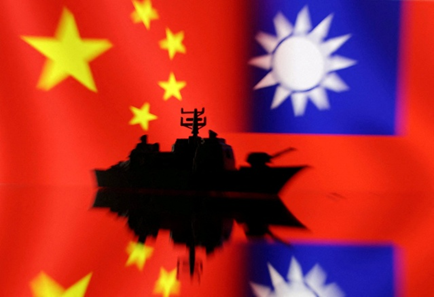
China Expands Patrols of Taiwan’s Pacific Coast, Raising Maritime Tensions
China has deployed on
average two Coast Guard cutters per month east of Taiwan since June, after
Japan and the Philippines announced plans to define their overlapping maritime
border in the region. The appearance of those vessels marks the first time such
patrols have been reported in the area in data going back to January
2025. Patrols in these waters
covered a vast area of 27,100 square nautical miles — more than twice the size
of Taiwan — based on Bloomberg calculations using ship-tracking data. Ships stayed
30 nautical miles from the island’s eastern coast, remaining outside
Taiwan-claimed waters. Controlling the
east would become essential to enforcing an effective blockade of Taiwan during
a Chinese invasion of the island. Disrupting shipping off the Pacific coast
would have global implications for commodities. Vessels ferrying oil, gas, iron
ore and agricultural products made 527 transits through the east in June,
exceeding the 420 through the generally busier Taiwan Strait, according to
MarineTraffic data.
“If the Taiwan Strait is the front door, the
eastern waters have often been treated as the back door,” said Jing
Ge, instructor at
Florida International University’s politics and international relations
department. “Beijing wants to demonstrate this back door is no longer
uncontested.”
While the Taiwan
Strait handles almost half the world’s container fleet, the island’s eastern coast
holds strategic importance by forming a maritime link with the Philippines and
wider Pacific. Sea lanes in the area lead to key ports and military facilities,
where the US and its regional allies could deliver supplies, while its deeper
waters are ideal for submarines and undersea surveillance. China’s Coast Guard has described such
deployments as “routine law-enforcement” patrols, and has pledged to strengthen
patrols to safeguard Beijing’s maritime rights. China has in the past also
conducted military drills, including in this area, to rehearse encircling
Taiwan, the self-governed island the Communist Party considers its own despite
never having ruled it. China’s activity
is an attempt to “leverage ‘law enforcement patrols’ to establish a new normal
for its maritime presence in the waters east of Taiwan,” the Taiwan Coast Guard
Administration said in an email. Vessels have been dispatched in a timely
manner in response, it added.
The US has called China’s actions “deeply destabilizing.” Despite that opposition, China’s Coast Guard
announced last week it had deployed a new set of vessels east of Taiwan,
sustaining its presence in the area.
The role of China’s
Coast Guard has moved beyond traditional law enforcement in recent years. That
was laid bare by the introduction of a Coast Guard Law in 2021, which expanded
the agency’s reach by authorizing it to “take all necessary measures, including
the use of weapons” to protect what Beijing defines as China’s
sovereignty.
Its new operations
around Taiwan started on June 1, when China’s Coast Guard deployed two large
patrol cutters — the 5,000-ton Daishan and the 3,000-ton Baita — to waters east
of the island. Those vessels were previously
used around the East China Sea, including the Japanese-controlled Senkaku islands, which China also
claims and calls the Diaoyus. Days
earlier, Japan and the Philippines had announced plans to start negotiations to
delimit their sea boundaries, as part of broader efforts from the two US allies
to deepen their partnership. China opposed the talks, saying they’d interfered
with its own maritime claims in that region.
“Beijing is using the
joint statement issued by Japan and the Philippines as a pretext for greatly
expanding its presence in these waters,” said Ryan
Martinson, assistant professor
at the China Maritime Studies Institute of the US Naval War College. Later
in June, China sent
larger law enforcement ships, the 10,000-ton Haixun 09 and the 6,600-ton Haixun
06, to circle Taiwan. That rare multi-agency operation included China’s
largest deep-sea survey ship and a rescue vessel.
During their five-day
voyage, the vessels for the first time questioned foreign commercial ships passing along
Taiwan’s Pacific coast. According to Chinese state media, the ships also “inspected” 198 passing vessels during the
mission to reinforce traffic-control capabilities. It was unclear what the
report meant by “inspected.” “If those
interactions become routine, the next question is whether Chinese authorities
begin to request more information,’ said Zack Liao, political risk
analyst at UK-based think tank China Strategic Risks Institute. “After that,
whether they issue navigational instructions.”
US-based independent monitor Armed
Conflict Location & Event Data has separately reported “a significant increase in research
vessels operating at unusually slow speeds east of Taiwan” near undersea
communications infrastructure. China kept up the pressure by sending two more Coast Guard cutters to relieve the
Daishan and Baita after a month in the area. That was described by a US congressional commission as Beijing’s way
to establish a continuous presence.
“Using the CCG rather
than the PLA Navy avoids military confrontations and allows Beijing to portray
these activities as law enforcement while establishing the persistent presence
necessary for a future blockade,” said the US-China Economic and Security
Review Commission.
As the activity ramped
up, Taiwan held military
exercises in mid-July on Orchid and Green Islands, off
its southeastern coast, for the first time in three decades. Weeks later, China
staged passing exercises with Indonesia
in the area, the first time Beijing has announced training with another country
in the eastern waters. China’s push to
establish a presence east of Taiwan ultimately puts pressure on the US to
respond, analysts say. “What Beijing
is testing east of Taiwan is whether it can gradually rewrite expectations
about who governs navigation and maritime order in the Western Pacific,” said
the China Strategic Risks Institute’s Liao. “That means the response should
also be international.”
Related News