


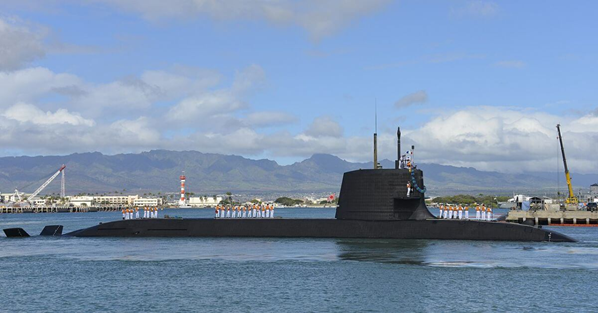
Japan Plans Submarine-Launched Mach 5 Hypersonic Missile to Strengthen Long-Range Strike Capability
The project is part of
Japan’s FY2027 defence budget request. The aim is to give Japan another way to
launch long-range missiles from submarines that are hard to detect. Japan’s Ministry of Defense included the
plan in its FY2027 budget request released at the end of August 2026. The request also includes about ¥48 billion
($325 million) to study an underwater vertical launch system, or VLS, for
larger long-range missiles on Japan Maritime Self-Defense Force (JMSDF)
submarines. Japan is also studying a
missile launch system for unmanned underwater vehicles, or UUVs. China has
improved its satellites, surveillance systems, missiles and air forces. These
systems can threaten Japanese air bases, naval facilities and known missile
sites. Land-based missile units can move. Warships can also change position.
But both can still be tracked by satellites and other surveillance systems. Submarines are harder to find when they are
underwater. Their exact location can remain unknown while they move toward a
launch area. This could help Japan keep
some long-range weapons available even after an enemy attack on its military
bases. Finding a submarine after it
launches a missile would also be difficult. An enemy could have to search a
large area of sea using submarines, anti-submarine aircraft, warships and
underwater sensors.
Japan has not said how
far the new missile will travel. It has also not given details about its size,
propulsion system or warhead. The ¥48 billion VLS research could allow future
JMSDF submarines to carry larger long-range missiles. Japan’s
current submarines use torpedo tubes to launch weapons. The Taigei-class submarines have six 533 mm
torpedo tubes and can launch weapons such as the Harpoon UGM-84. Torpedo tubes limit the size of a missile. A VLS could provide larger launch cells. It
could also give missiles more room for propulsion and possibly allow them to
travel farther. At the same time, the
torpedo tubes could remain available for anti-submarine and anti-surface
warfare. Japan will need to study how the VLS can
work safely underwater. This includes the structure of the launch system, how
the missile leaves the submarine and how the launch affects the submarine’s
stability. Japan also wants to study a missile launch module for UUVs. Tokyo has not said how large these UUVs
would be, what missiles they would carry or how the launch system would work. There is also no indication that the planned
hypersonic missile itself would be carried by a UUV. In the future, UUVs carrying missiles could
give Japan more launch positions without putting submarine crews at risk. They could also make it harder for an
enemy to find all of Japan’s underwater weapons. The submarine missile plan is part of
Japan’s effort to build stand-off weapons.
Japan is improving its Type 12
surface-to-ship missile family. It is also working on hypersonic and other
high-speed weapons. Japan is acquiring U.S.-made Tomahawk cruise missiles and
other air-launched stand-off weapons. It is also looking at a cheaper stand-off
weapon to work alongside more expensive systems. Hypersonic missiles are likely to cost more
and be available in smaller numbers. They could be used against important
targets where speed is important. Cheaper
missiles could be used in larger numbers and for longer operations. The submarine will also need accurate
information about its targets. Japan
is investing in space-based surveillance, sensor networks, AI-based satellite
data processing and communications systems for stand-off weapons. This is important because targets such as
warships can move. A submarine could be hundreds of kilometres
from its target and remain hidden. It cannot track every target from that
distance on its own. Japan could use
information from satellites, maritime patrol aircraft, surface
ships, unmanned aircraft and other systems. This would
allow the submarine to stay hidden while receiving information from other
platforms. The same system could help
Japan and the United States keep using long-range weapons if some air bases,
ships or land-based launchers are damaged.
If the VLS program moves ahead, future JMSDF submarines could have more
long-range strike missions.
They could still be used for anti-submarine
warfare, intelligence gathering and attacks on surface ships.
They could also carry long-range missiles for
targets such as command centres, missile batteries, air-defence systems and
naval facilities. The Taigei class is Japan’s latest attack submarine class. Japan has
commissioned up to five submarines in the class.
The latest boat, JS
Chōgei (SS-517), was launched in March 2026.
The Taigei class was also designed to test new technologies, with later
boats receiving improvements. Kawasaki
Heavy Industries has been working on a new diesel-electric attack submarine
design since December 2023.
Japanese Defence
Minister Shinjirō Koizumi has also discussed the need for nuclear-powered
submarines.
Related News