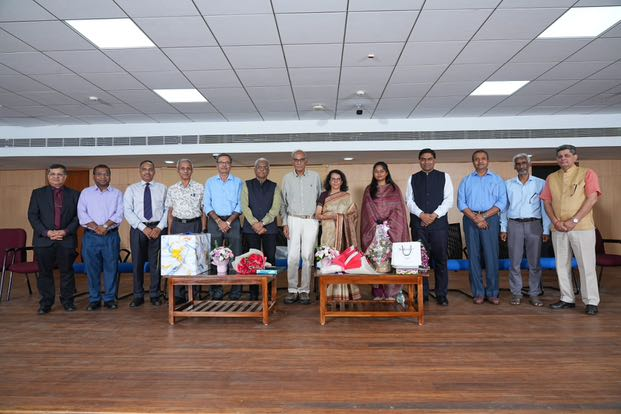
IIT Madras hosts Global Hyperloop Summit to advance high-speed, sustainable transport
The Summit brought together stakeholders from
government, ports, railways, logistics, industry, academia and research to
discuss the development of Hyperloop technology and its potential applications
in transportation and logistics. Held
at its ‘Discovery’ satellite Campus in Thaiyur near Chennai on Saturday (19th
Sept 2026), a key highlight of the Summit was the signing of an agreement
between TuTr Hyperloop and Larsen and Toubro (L&T), marking an important
step towards strengthening industry participation in developing
Hyperloop-related technologies.
Through Parivahan 2.0, IIT Madras and its partners provided a platform
for researchers, students, policymakers and industry stakeholders to exchange
perspectives, explore collaborations and discuss pathways for advancing
Hyperloop technologies and their potential applications in India’s future
transportation and logistics systems.
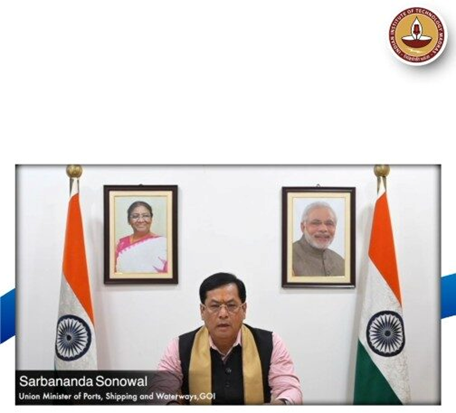
Graced virtually by
Shri Sarbananda Sonowal ji, Union
Minister of Ports, Shipping and Waterways, the Summit explored
applications of Hyperloop in freight, logistics, port connectivity and future
mobility, alongside the technological, infrastructure, regulatory and
commercial pathways needed for its development. Addressing the event virtually, Shri Sonowal said, “Under the
vision of Hon’ble Prime Minister Shri
Narendra Modi ji, India is building towards a modern, clean, green and
high-speed logistics network as we work towards Viksit Bharat 2047. Emerging
technologies such as Hyperloop can play an important role in connecting ports
with logistics parks, warehouses, industrial clusters and inland freight
terminals, enabling faster and more efficient movement of cargo. I am
particularly pleased to see the progress at Deendayal Port Authority, Kandla,
with TuTr Hyperloop’s LIM technology demonstrator, followed by the Maglev
technology. It represents a historic step in taking this technology from the
laboratory to the port, and from technology demonstration towards commercialisation.” Shri Sarbananda Sonowal added, “This
collaboration demonstrates how Indian deep tech can be developed, tested and
taken towards real-world deployment. This is the collaborative model India
needs: academia, industry and user organisation working together. It is the
true spirit of Make in India: innovate in India, build in India, and take
Indian technology to the world. As we move towards Viksit Bharat 2047, our
ambition should be to move beyond technology demonstration and work towards a full-scale
cargo Hyperloop system as part of India’s future logistics network. I hope
student teams from India and across the world will develop concepts that can
find real-world applications in ports, freight and logistics.” Often described as the ‘fifth mode of
transport’, Hyperloop is an emerging high-speed transportation system in which
electromagnetically levitating pods travel through low-pressure or vacuum
tubes. By reducing friction and air resistance, the technology has the
potential to enable high-speed movement of passengers and freight, with
applications in logistics, port connectivity and sustainable mobility. Addressing the Summit, Prof. V. Kamakoti, Director, IIT Madras, said, “Hyperloop
has been very close to the heart of IIT Madras. It was the first big
interdisciplinary project we saw, with 72 members spread across six or seven
departments, and the first barrier we have broken is that we have made several
departments talk to each other. If we have our own technology, we are surely going
to succeed. No standard is going to be acceptable on paper; we must demonstrate
it on real platforms, and we have a platform here. I want to see the day when
there are bookings for the tube and teams are competing to use it. I would also
like TuTr Hyperloop to bring Hyperloop clubs to IITs across India and to
develop skill-development courses on structures, levitation, propulsion and
related areas, which we can offer on SWAYAM and SWAYAM Plus.” The Summit examined how Hyperloop could be
integrated into future transportation networks, particularly for freight
movement, port-to-hinterland connectivity and logistics. Discussions also
addressed the technological, infrastructure, regulatory and commercial
requirements for developing a Hyperloop ecosystem in India.
Highlighting the research and technology development aspects, Prof.
Satya Chakravarthy, Faculty Advisor, IIT Madras, said, “As we prepare
for the third edition of the Global Hyperloop Competition in 2027, a
significant milestone is its integration with Shaastra, IIT Madras’ annual
technical festival. While the competition was successfully conducted in 2024
and 2025 through student-led efforts, its inclusion within Shaastra provides a
strong institutional framework and ensures continuity for years to come. This
enables the competition to grow sustainably while expanding its global reach.
Technology is inherently global, and by bringing the Global Hyperloop
Competition under the Shaastra umbrella, we are creating a platform that can
connect students, researchers, innovators and industry from around the world to
advance the future of transportation technologies.” Shri Sushil Kumar Singh, Chairman,
Deendayal Port Authority, added, “There are numerous use cases across
different sectors of the economy where Hyperloop technology can create value.
The Global Hyperloop Competition serves as an important platform that brings
together innovators, technology developers, students, researchers, user
departments and industry to explore the possibilities and viability of
Hyperloop-based transportation solutions. GHC 2027 will provide a global
platform for students, universities, researchers and startups from around the
world to develop new ideas and demonstrate the potential of next-generation
transportation.” The programme featured addresses by senior
representatives from IIT Madras, TuTr Hyperloop, Deendayal Port Authority,
Central Warehousing Corporation, Southern Railways and BEML. Representatives
and experts from CONCOR, NTPCWC, IITM Pravartak Foundation, GalaxEye, The
ePlane Company, L&T, SYSTRA, AVL India and other organisations also
participated. The discussions covered
Hyperloop technology and infrastructure; freight and logistics; ports and
transportation connectivity; digital and smart transportation systems;
sustainability and green mobility; policy, regulation and industry
collaboration; AI, automation and future mobility; deeptech innovation and
commercialisation; and student innovation.
The technical sessions focused on key components of Hyperloop
systems. Prof. R. K. Shrivastava, IIT (BHU), delivered a technical address
on Linear Induction Motor Applications, including work undertaken at IIT (BHU).
Dr. Shinde, Outstanding Scientist, Department of Atomic Energy, Government of
India, spoke on Magnetic Levitation, a core technology for enabling contactless
movement of Hyperloop pods. These sessions provided participants with insights
into the engineering principles, research challenges and technological
opportunities associated with Hyperloop development. Four panel discussions on the opportunities
and challenges of a Hyperloop ecosystem were also discussed. The Summit concluded with a discussion on
“Way Forward – Industry, Government & Academia Collaboration”, focusing on
potential areas for continued cooperation among stakeholders.
Related News