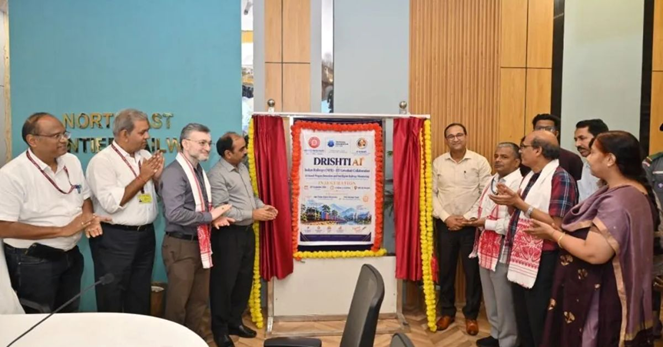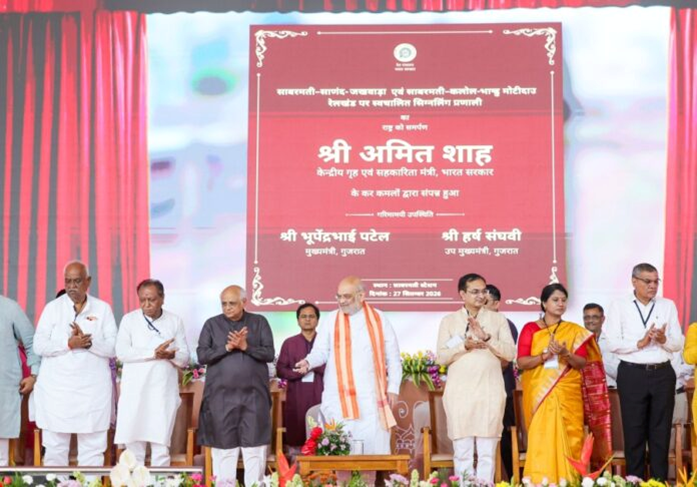
Amit Shah inaugurates development projects worth ₹1,472 crore and flagged off the country’s first LNG-powered train from Sabarmati Railway Station in Ahmedabad
He also inaugurated the WAG-12 Maintenance Shed being established for the maintenance of railway locomotive
engines. Gujarat Chief Minister Shri
Bhupendra Patel and several other dignitaries were present on the
occasion. Addressing the programme,
Union Home Minister and Minister of Cooperation Shri Amit Shah said that
several railway projects have been initiated yesterday in the Sabarmati
division, focusing on environmental sustainability, passenger amenities and the
safety of rail passengers. He said, Satyagraha, simple living, rural
development and khadi, the journey of translating all these experiments into
action on the ground began from Sabarmati itself. Shri Amit Shah said that
Sabarmati Railway Station has now undergone significant development, but in the
1980s, passengers had to walk nearly two kilometres even to find a rickshaw
from the station. He said that the Sabarmati Railway Station has witnessed a
major transformation in terms of passenger amenities, safety and connectivity.
Shri Shah said that
the development works inaugurated and foundation stones laid today, at a cost
of ₹1,472 crore, will prove to be highly significant for the region in the
coming days. He said that a WAG-12 Maintenance Shed has been constructed here
at a cost of ₹700 crore for the maintenance of railway locomotive engines. The
‘Kavach’ train protection system has been introduced on the
Sabarmati–Kalol–Sabarmati rail section at a cost of ₹48 crore to enhance safety.
In addition, works have commenced for the implementation of ‘Kavach’ on the
Ahmedabad–Palanpur and Ahmedabad–Samakhiali rail sections, as well as the
doubling of the Sabarmati–Sarkhej railway line. Shri Amit Shah said that today, an engine
with a 12,000-horsepower twin-section capacity has been commissioned, which can
haul nearly as much freight as 600 trucks single-handedly. Earlier, two
locomotives were required for this purpose, but now a single WAG-12 can perform
the same task. He said that this will mark an important milestone in the
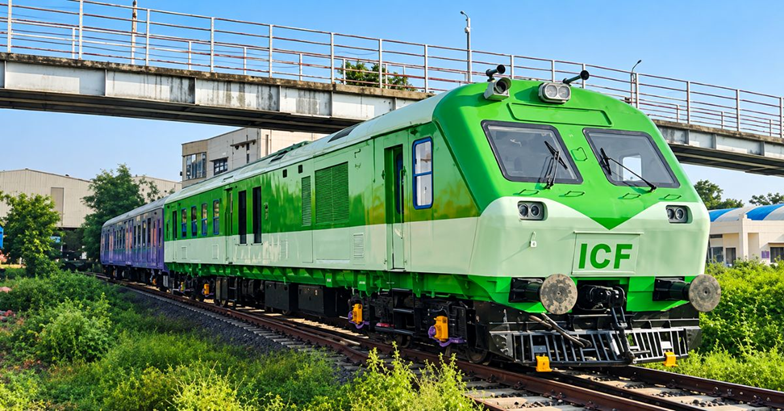
history of Indian Railways. Shri Shah said that a LNG-powered train has also
been inaugurated today, which will make a significant contribution to
environmental conservation in the years to come. Union Home Minister Shri Amit Shah said
that after Shri Narendra Modi
became Prime Minister in 2014, several new facilities were introduced in the
railways and the railway network was modernised. He said that the successful
trial of the country’s first double-stack long-haul container train from Jawaharlal Nehru Port Trust (JNPT), Mumbai, to
Vadodara has been completed. He said that the country has limited rail tracks
for freight transportation, but if the concept of double-stack freight trains
succeeds, the freight-carrying capacity will nearly double. He said that an
11,000-kilometre-long corridor is now being converted into a four-lane network,
which will significantly facilitate traffic movement towards Delhi–Howrah and
Delhi–Guwahati. Shri Amit Shah said
that it was under the leadership of Prime Minister Modi that the Dedicated
Freight Corridors, the Rapid Rail System and premium railway stations were
introduced. He said that recently, Prime Minister Modi inaugurated a
hydrogen-powered train, making India one of only four countries in the world to
possess this technology. He said that 97 per cent of bio-toilets were installed
during the Modi government’s tenure. 87 per cent of LHB coaches were manufactured
in India during the Modi government’s tenure. Railway electrification stood at
only 30 per cent before Prime Minister Modi assumed office, while the remaining
70 per cent was completed during his tenure. He said that under the Modi
government, the railway safety budget has increased by 67 per cent, while
locomotive production capacity has increased by 66 per cent. Union Home Minister Shri Amit Shah said
that Prime Minister Modi launched the concepts of ‘Make in India’ and ‘Aatmanirbhar
Bharat’, and as a result, the country has now made
significant progress towards manufacturing equipment such as locomotives
domestically. He said that in 2015–16, the railways consumed 293 crore litres
of diesel, but this has declined to 108 crore litres in 2024–25. He said this
is a major achievement that receives relatively little attention. Shri Shah
said that railway electrification was only 75 kilometres in an entire year in
2010–11, whereas 7,188 kilometres were electrified in a single year in 2023–24.
He said that 99.6 per cent of the railway network has now been electrified, and
the remaining 0.4 per cent will also be completed soon. He said that railway
electrification stands at 92 per cent in China, 68 per cent in Spain, 60 per
cent in France and 49 per cent in the United Kingdom, a relatively small
country. India will surpass these countries by achieving 100 per cent
electrification. He said that Sweden is the only country in the world to have
achieved 100 per cent railway electrification, but the total length of railway
lines in Sweden is nearly ten times less than that of India. Union Home Minister Shri Amit Shah said
that, if Gujarat is taken as an example in terms of the railway budget, the
rail budget from 2009 to 2014 was merely ₹589 crore. In contrast, the budget
for just one year, 2026–27, stands at ₹17,366 crore. He said that the
difference in the pace of development is clearly visible. He said that the
people of the country should tell opposition party leaders who make reckless
statements to discuss issues with facts and figures. Shri Shah questioned the
opposition party about what it had done during its tenure. He said that apart
from scams, scandals and corruption amounting to ₹12 lakh crore over 10 years,
the opposition party had done nothing. Shri Shah said that in 12 years, not
even the slightest allegation of corruption has been levelled against Modi Ji.
Related News