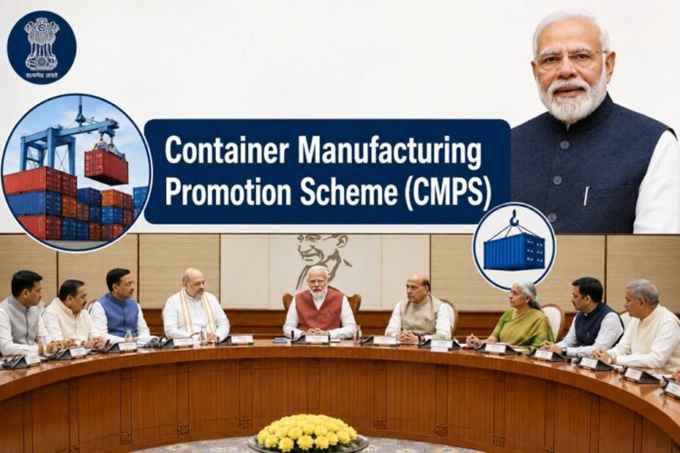
Cabinet approves Rs 10,000 crore scheme to make India a global container manufacturing hub
The scheme will
support new factories as well as the expansion of existing units. It aims to
lift India’s annual container manufacturing capacity around ten-fold, to 7.5
lakh TEUs, from about 70,000 TEUs today. Union Minister of Ports, Shipping & Waterways (MoPSW), Shri
Sarbananda Sonowal welcomed this announcement by thanking Prime Minister
Narendra Modi for emboldening Make In India push in container manufacturing in
the country. “I express my heartfelt
gratitude to Prime Minister Shri Narendra Modi ji for his visionary leadership.
His Make in India push is giving our container manufacturers the confidence to
build at scale, and this scheme is a strong step to reduce import dependence,”
Sarbananda Sonowal said. India’s trade
depends on containers, but almost all of them are made abroad. India’s
container traffic is projected to grow from about 24 million TEUs in 2024 to
175 million TEUs by 2047 under the Maritime Amrit Kaal Vision, which makes
home-grown capacity critical. •
Interest Subvention Assistance (Rs 859 crore): 3 per cent a year on eligible
term loans for greenfield plants of at least 1,00,000 TEUs a year and
brownfield expansions of at least 25,000 TEUs a year. • Operational Expenditure Assistance (Rs
8,891 crore): support for every container made to global shipping standards and
sold by an eligible manufacturer, Rs 49,500 for a 20-foot and Rs 86,625 for a
40-foot container, to bridge the cost gap with imports. Domestic content must
rise from 70 per cent to 90 per cent.
• Testing and Certification (Rs 150 crore): common facilities, such as
dynamic longitudinal impact testing, to reduce dependence on overseas
testing. • Scheme management (Rs 100
crore): administration, monitoring and capacity building. • Land at major ports: leasing support at
25 per cent of the notified rate. An
Inter-Ministerial Steering Committee chaired by the Secretary, Ministry of
Ports, Shipping and Waterways, will approve guidelines and sanction
assistance. The scheme is expected to
create about 3,000 direct and more than 50,000 indirect jobs, in steel,
components and logistics. It will also support ancillary industries such as
corner castings, specialised steel, wooden frames and paints. The government estimates it will
generate about Rs 75,000 crore of economic output by FY 2039-40, more than
seven times the support provided. Demand is expected from replacement of the
global fleet, the Bharat Container Shipping Line, and new mega ports such as
Vadhavan and Galathea Bay.
“Containers are the
backbone of our trade. By making them in India, we strengthen the maritime
logistics supply chain on which our ports, our exporters and
our shipping
lines depend, and we take another step towards a self-reliant India and the
goals of Maritime Amrit Kaal Vision 2047,” Sonowal added.
Related News