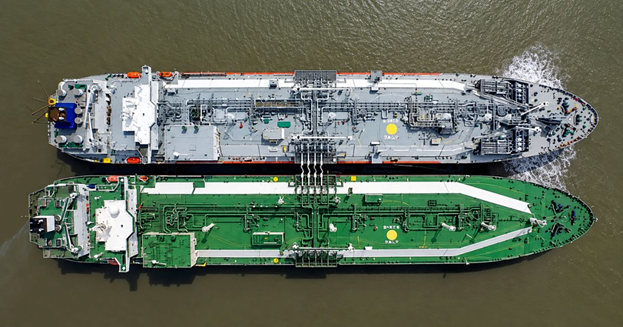
Bangladesh approves 600 mmcfd floating LNG terminal at Moheshkhali
The proposed floating storage
and regasification unit (FSRU) will receive LNG from carriers, store it and
convert it back into gas for delivery to Bangladesh’s national transmission
network. It will have a standard regasification capacity of 600 million cubic
feet per day (mmcfd), with peak output of 750 mmcfd. CNEE’s proposal envisages
operations starting in 2028.
Bangladesh’s two existing floating terminals, both at Moheshkhali, have
a combined capacity of about 1,100 mmcfd. The third unit would raise that
figure to 1,700 mmcfd at standard output, an increase of about 55 per cent.
Combined capacity could reach 1,850 mmcfd when the new unit operates at peak
output. The Cabinet Committee on
Government Purchase cleared the state-owned Chinese company’s proposal under a
government-to-government arrangement. The proposal sets out two options,
costing Tk 123.24 billion (Tk 12,324 crore) over 15 years or Tk 131.61 billion
(Tk 13,161 crore) over 20 years. The committee had deferred the proposal in
October to review its financial terms and approved it in November at the
proposed cost. Under the 15-year
option, CNEE proposed a daily service fee of US$342,000. That is about 35 per
cent above the fee for Excelerate Energy’s terminal and 37 per cent above the
rate for Summit LNG’s facility. The purchase approval did not specify the final
daily fee or the commissioning date.
Bangladesh requires about 3,800 mmcfd of gas, while domestic production
and LNG imports typically supply around 2,700 mmcfd. The resulting shortfall of
about 1,100 mmcfd has put pressure on power producers and industrial users. An
outage at either of the two existing terminals can further disrupt
supplies. Excelerate Energy
commissioned Bangladesh’s first LNG import terminal at Moheshkhali in 2018, and
Summit’s facility followed in 2019. In October 2024, state-owned Petrobangla
terminated a separate agreement with Summit Group for a third floating
terminal, citing procurement concerns. Summit challenged the decision. Bangladesh also advanced several LNG supply
proposals on 12 November. The government cleared a short-term procurement
arrangement involving Japan’s JERA Global Markets and gave in-principle
approval for imports from suppliers in the United Arab Emirates and Nigeria.
The purchase committee also approved two
cargoes from Malaysia’s Petronas and three side letters covering 2027
deliveries from Oman’s OQ Trading.

Related News