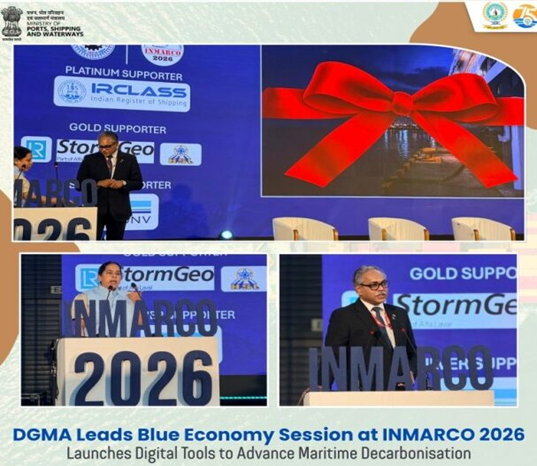
INMARCO 2026: DGMA launches two green maritime digital tools to drive India’s Blue Economy and decarbonisation agenda
Shri Shyam Jagannathan, IAS, Director General of
Maritime Administration (DGMA), chaired the session and delivered an address
supported by a presentation titled “India’s Blue Economy: Charting the Course
towards Maritime Excellence and Sustainability”. In his address, the Director General
highlighted the growing significance of the Blue Economy in India’s economic
development and the country’s expanding maritime capabilities. He emphasised
the importance of strengthening maritime infrastructure, promoting indigenous
shipbuilding, implementing progressive legislative reforms, encouraging
technological innovation and accelerating maritime decarbonisation. He also outlined the relevance of these
initiatives in achieving the objectives of Maritime India Vision 2030 (MIV 2030) and Maritime Amrit Kaal Vision 2047 (MAKV 2047), which provide a
strategic roadmap for transforming India into a globally competitive maritime
nation. A major highlight of the
session was the formal launch of two specialised digital tools developed by the
National Centre of Excellence in Green
Ports and Shipping (NCoEGPS–TERI) by the Director General of Maritime
Administration. The newly launched
tools are designed to support data-driven decision-making, improve operational
assessments and encourage the adoption of sustainable maritime practices. Maritime CO₂ Emission & Implied
Carbon Tax Calculator The tool is
designed to estimate carbon dioxide emissions from vessels and assess
indicative carbon-cost implications under different reference scenarios. It is
expected to help maritime stakeholders better understand vessel emissions and
evaluate the potential financial implications associated with carbon
emissions. Shore to
Ship Power Estimator PRO Tool This tool enables
users to assess the potential benefits of shore power utilisation during vessel
port stays. It evaluates possible fuel savings, reductions in emissions and
associated operating-cost implications, providing useful insights into the
adoption of shore-to-ship electricity solutions at ports. The launch of these digital platforms
marks an important step towards integrating technology, environmental
accountability and practical sustainability solutions into India’s maritime
ecosystem. By providing analytical
tools for assessing vessel emissions, carbon-related costs and shore power
benefits, the initiative aims to encourage informed investment decisions and
accelerate the transition towards cleaner and more energy-efficient port and
shipping operations. The discussions
at INMARCO 2026 reaffirmed the importance of collaborative efforts among
government institutions, maritime organisations, research bodies and industry
stakeholders in unlocking the full potential of India’s Blue Economy.
Through policy
initiatives, technological innovation and the adoption of sustainable maritime
practices, India continues to advance its ambition of building a modern,
competitive and environmentally responsible maritime sector in line with its
long-term vision for 2047.
Related News